In a recent cytogenetic study on 1021 cases of Down syndrome, 46 were the result of translocations, the most frequent of which was symbolized as t(14;21). What does this symbol represent, and how many chromosomes would you expect to be present in t(14;21) Down syndrome individuals?
Klug 10th Edition
Ch. 6 - Chromosome Mutations: Variation in Number and Arrangement
Problem 23bA boy with Klinefelter syndrome (47,XXY) is born to a mother who is phenotypically normal and a father who has the X-linked skin condition called anhidrotic ectodermal dysplasia. The mother's skin is completely normal with no signs of the skin abnormality. In contrast, her son has patches of normal skin and patches of abnormal skin.
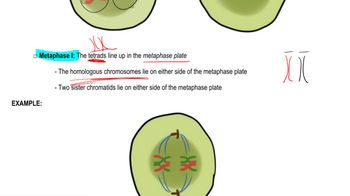
Using the appropriate genetic terminology, describe the meiotic mistake that occurred. Be sure to indicate in which division the mistake occurred.
Verified step by step guidance
Verified video answer for a similar problem:
Key Concepts
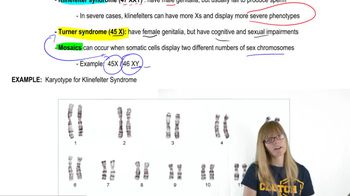
Klinefelter Syndrome (47,XXY)
Nondisjunction in Meiosis I and II
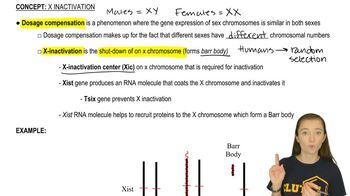
X-linked Inheritance and Mosaicism due to X-inactivation
A boy with Klinefelter syndrome (47,XXY) is born to a mother who is phenotypically normal and a father who has the X-linked skin condition called anhidrotic ectodermal dysplasia. The mother's skin is completely normal with no signs of the skin abnormality. In contrast, her son has patches of normal skin and patches of abnormal skin.
Which parent contributed the abnormal gamete?
A boy with Klinefelter syndrome (47,XXY) is born to a mother who is phenotypically normal and a father who has the X-linked skin condition called anhidrotic ectodermal dysplasia. The mother's skin is completely normal with no signs of the skin abnormality. In contrast, her son has patches of normal skin and patches of abnormal skin.
Using the appropriate genetic terminology, explain the son's skin phenotype.
A 3-year-old child exhibited some early indication of Turner syndrome, which results from a 45,X chromosome composition. Karyotypic analysis demonstrated two cell types: 46,XX (normal) and 45,X. Propose a mechanism for the origin of this mosaicism.
The woman in Problem 24 has had two miscarriages. She has come to you, an established genetic counselor, with these questions:
Is there a genetic explanation of her frequent miscarriages?
Should she abandon her attempts to have a child of her own?
If not, what is the chance that she could have a normal child? Provide an informed response to her concerns.