Skip to main content
Genetics
My Course
Learn
Exam Prep
AI Tutor
Study Guides
Textbook Solutions
Flashcards
Explore
Try the app
My Course
Learn
Exam Prep
AI Tutor
Study Guides
Textbook Solutions
Flashcards
Explore
Try the app
Back
Overview of Eukaryotic Gene Regulation definitions
You can tap to flip the card.
Transcription Initiation
You can tap to flip the card.
👆
Transcription Initiation
First step in gene expression where regulatory proteins and DNA sequences determine if a gene will be transcribed.
Track progress
Control buttons has been changed to "navigation" mode.
1/15
Related flashcards
Related practice
Recommended videos
Overview of Eukaryotic Gene Regulation quiz #1
Overview of Eukaryotic Gene Regulation
17 Terms
Overview of Eukaryotic Gene Regulation
13. Gene Regulation in Eukaryotes
7 problems
Topic
Kylia
GAL Regulation
13. Gene Regulation in Eukaryotes
7 problems
Topic
Kylia
13. Gene Regulation in Eukaryotes
4 topics
11 problems
Chapter
Kylia
Guided course
09:22
Review of Regulation
5
views
Terms in this set (15)
Hide definitions
Transcription Initiation
First step in gene expression where regulatory proteins and DNA sequences determine if a gene will be transcribed.
Transcription Factor
Protein that binds specific DNA sequences to activate or suppress gene transcription, influencing gene expression.
Promoter
DNA sequence near a gene that recruits proteins to start transcription, acting as a control point for gene expression.
Enhancer
Regulatory DNA element that increases transcription levels, often acting from a distance relative to the gene.
Silencer
DNA sequence that reduces or prevents transcription when bound by specific proteins, decreasing gene expression.
DNA Binding Motif
Structural feature in proteins enabling specific attachment to DNA, crucial for gene regulation.
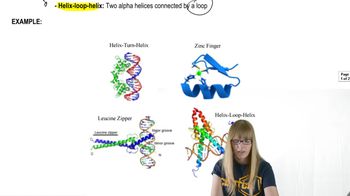
Helix-Turn-Helix
Protein motif with two alpha helices separated by a turn, facilitating DNA binding for gene regulation.
Zinc Finger
Protein structure stabilized by zinc ion, resembling a finger, that interacts with DNA to regulate genes.
Leucine Zipper
Dimeric protein motif where two subunits join at leucine residues, resembling a zipper, to bind DNA.
Helix-Loop-Helix
Protein motif with two helices connected by a loop, allowing DNA interaction for transcription control.
RNA Processing
Modification of RNA transcripts, including capping, tailing, and splicing, to produce mature mRNA.
Alternative Splicing
Process where different exon combinations from one gene create multiple protein isoforms, diversifying function.
RNA Interference
Mechanism using small RNAs to degrade specific mRNA transcripts, reducing gene expression post-transcriptionally.
mRNA Degradation
Regulatory process where mRNA molecules are broken down, controlling protein production and gene expression.
Protein Isoform
Variant of a protein produced from the same gene via alternative splicing, potentially altering cellular function.
 BackBack
 09:22
09:22