Skip to main content
Genetics
My Course
Learn
Exam Prep
AI Tutor
Study Guides
Textbook Solutions
Flashcards
Explore
Try the app
My Course
Learn
Exam Prep
AI Tutor
Study Guides
Textbook Solutions
Flashcards
Explore
Try the app
Back
Overview of Cancer definitions
You can tap to flip the card.
Proliferation
You can tap to flip the card.
👆
Proliferation
Unregulated increase in cell number due to excessive growth and division, a hallmark of tumor formation.
Track progress
Control buttons has been changed to "navigation" mode.
1/15
Related flashcards
Related practice
Recommended videos
Overview of Cancer quiz #1
Overview of Cancer
10 Terms
Overview of Cancer
19. Cancer Genetics
7 problems
Topic
Kylia
Cancer Mutations
19. Cancer Genetics
7 problems
Topic
Kylia
19. Cancer Genetics
2 topics
6 problems
Chapter
Kylia
Guided course
08:34
Cancer Causes
3
views
Guided course
09:46
Cancer Characteristics
8
views
Terms in this set (15)
Hide definitions
Proliferation
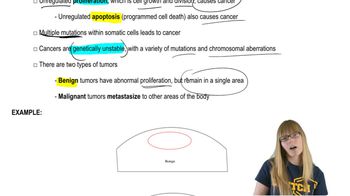
Unregulated increase in cell number due to excessive growth and division, a hallmark of tumor formation.
Apoptosis
Programmed cell death process; its disruption allows abnormal cells to survive and accumulate.
Mutation
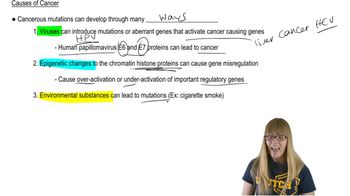
Permanent alteration in DNA sequence; accumulation leads to genetic instability in tumors.
Genetic Instability
High frequency of mutations and chromosomal changes, resulting in diverse tumor cell populations.
Benign Tumor
Localized abnormal cell mass with clear boundaries, often removable with high survival rates.
Malignant Tumor
Aggressive abnormal cell mass capable of invading other tissues and spreading throughout the body.
Metastasis
Spread of cancer cells from the original site to distant organs, complicating treatment.
Tumorigenesis
Multistep process leading to tumor development, often involving mutations in regulatory pathways.
Signal Transduction Pathway
Network of proteins transmitting signals to control gene expression and cell behavior.
Clonality
Origin of a tumor from a single mutated cell, with all progeny inheriting initial and subsequent mutations.
Cancer Stem Cell
Self-renewing cell within a tumor, capable of generating both new stem cells and tumor cells.
Epigenetic Change
Modification of DNA packaging proteins affecting gene expression without altering DNA sequence.
Cell Cycle
Ordered sequence of events in cell growth and division, tightly regulated by specific proteins.
Checkpoint
Control point in the cell cycle ensuring DNA integrity before progression to the next phase.
Cyclin Dependent Kinase
Enzyme activated by cyclins, adding phosphates to proteins to regulate cell cycle transitions.
 BackBack
 08:34
08:34