Skip to main content
Genetics
My Course
Learn
Exam Prep
AI Tutor
Study Guides
Textbook Solutions
Flashcards
Explore
Try the app
My Course
Learn
Exam Prep
AI Tutor
Study Guides
Textbook Solutions
Flashcards
Explore
Try the app
Back
DNA Repair definitions
You can tap to flip the card.
DNA Proofreading
You can tap to flip the card.
👆
DNA Proofreading
Correction of mispaired bases during replication by removing incorrect nucleotides and restoring proper base pairing.
Track progress
Control buttons has been changed to "navigation" mode.
1/15
Related flashcards
Related practice
Recommended videos
DNA Repair quiz #1
DNA Repair
40 Terms
DNA Repair quiz #2
DNA Repair
10 Terms
DNA Repair
17. Mutation, Repair, and Recombination
7 problems
Topic
Kylia
Induced Mutations
17. Mutation, Repair, and Recombination
7 problems
Topic
Kylia
17. Mutation, Repair, and Recombination
4 topics
10 problems
Chapter
Nicole
Guided course
01:45
DNA Proofreading
5
views
Guided course
05:44
Repair Pathways
8
views
Guided course
03:03
Double Strand Breaks
5
views
Terms in this set (15)
Hide definitions
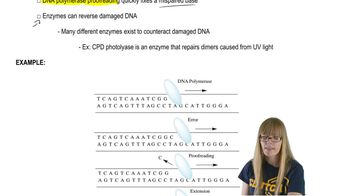
DNA Proofreading
Correction of mispaired bases during replication by removing incorrect nucleotides and restoring proper base pairing.
Base Excision Repair
Removal and replacement of damaged bases using glycosylases, followed by gap filling and sealing by polymerase and ligase.
DNA Glycosylase
Enzyme that recognizes and removes damaged bases from the DNA backbone, initiating base excision repair.
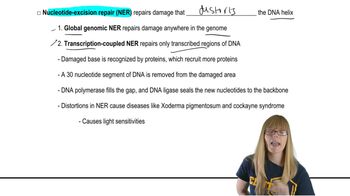
Nucleotide Excision Repair
Repair of helix-distorting lesions by excising a DNA segment, then filling and sealing the gap to restore structure.
Global Genome Repair
Pathway of nucleotide excision repair that targets lesions anywhere in the genome, regardless of transcriptional activity.
Transcription-Coupled Repair
Specialized nucleotide excision repair focused on actively transcribed DNA regions to quickly resolve transcription-blocking lesions.
Mismatch Repair
Correction of insertion or deletion errors post-replication by distinguishing new DNA strands via methylation status.
Methylation
Chemical modification marking the original DNA strand, allowing repair systems to identify newly synthesized DNA.
Translesion Synthesis
Error-prone DNA replication across damaged regions using specialized polymerases lacking proofreading ability.
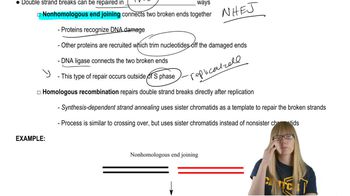
Double-Strand Break
Severe DNA damage involving breaks in both strands, requiring specialized repair mechanisms to restore integrity.
Non-Homologous End Joining
Repair of double-strand breaks by directly joining broken DNA ends, often resulting in loss of genetic information.
Homologous Recombination
Accurate repair of double-strand breaks using a sister chromatid as a template, restoring lost genetic material.
Sister Chromatid
Identical DNA copy produced during replication, serving as a template for homologous recombination repair.
DNA Ligase
Enzyme that seals nicks in the DNA backbone, completing the repair process after gap filling.
Bypass Polymerase
Specialized enzyme capable of synthesizing DNA across damaged regions but with high error rates and no proofreading.
 BackBack

 01:45
01:45