Skip to main content
Genetics
My Course
Learn
Exam Prep
AI Tutor
Study Guides
Textbook Solutions
Flashcards
Explore
Try the app
My Course
Learn
Exam Prep
AI Tutor
Study Guides
Textbook Solutions
Flashcards
Explore
Try the app
Back
Development of Plant Gametes definitions
You can tap to flip the card.
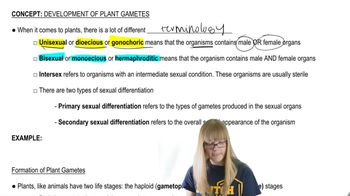
Unisexual
You can tap to flip the card.
👆
Unisexual
Describes organisms containing only male or only female organs, not both, commonly seen in humans and some plants.
Track progress
Control buttons has been changed to "navigation" mode.
1/15
Related flashcards
Related practice
Recommended videos
Development of Plant Gametes quiz #1
Development of Plant Gametes
10 Terms
Development of Plant Gametes
9. Mitosis and Meiosis
3 problems
Topic
Brendan
Development of Animal Gametes
9. Mitosis and Meiosis
4 problems
Topic
Kylia
9. Mitosis and Meiosis
4 topics
10 problems
Chapter
Kylia
Guided course
02:56
Plant Gamete Terminology
2
views
Guided course
04:06
Formation of Plant Gametes
1
views
Guided course
02:44
Chlamydomonas
2
views
Terms in this set (15)
Hide definitions
Unisexual
Describes organisms containing only male or only female organs, not both, commonly seen in humans and some plants.
Bisexual
Refers to organisms possessing both male and female organs, allowing for self-fertilization in many plant species.
Intersex
Indicates an intermediate or mixed sexual condition, often resulting in sterility due to atypical organ development.
Primary Sexual Differentiation
Classification based on the type of gametes produced, such as eggs or pollen, not visible externally.
Secondary Sexual Differentiation
Classification based on visible sexual organs, allowing external identification of male or female structures.
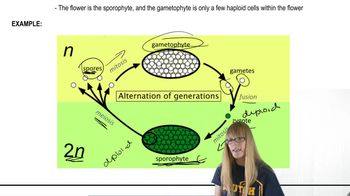
Gametophyte
Haploid stage in the plant life cycle, arising from spores and responsible for producing gametes.
Sporophyte
Diploid stage in the plant life cycle, generating haploid spores through meiosis.
Microspore
Haploid cell formed by meiosis in male organs, which divides to produce pollen grains.
Megaspore
Haploid cell produced by meiosis in female organs, with typically one surviving to form the embryo sac.
Stamen
Male reproductive organ in flowers, containing microsporocytes that give rise to pollen.
Stigma
Part of the female reproductive organ in flowers, serving as the landing site for pollen.
Embryo Sac
Female gametophyte structure in flowering plants, containing eight haploid nuclei after mitotic divisions.
Zygote
Diploid cell resulting from the fusion of male and female gametes, initiating the next sporophyte generation.
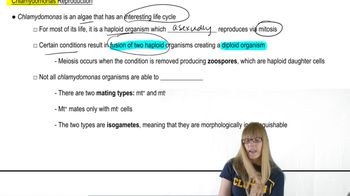
Isogamete
Gametes that are morphologically indistinguishable but differ internally, as seen in certain algae.
Mating Type
Genetic classification in some algae, such as MT+ and MT-, determining compatibility for fusion.
 BackBack

 02:56
02:56