Skip to main content
Genetics
My Course
Learn
Exam Prep
AI Tutor
Study Guides
Textbook Solutions
Flashcards
Explore
Try the app
My Course
Learn
Exam Prep
AI Tutor
Study Guides
Textbook Solutions
Flashcards
Explore
Try the app
Back
Development of Animal Gametes definitions
You can tap to flip the card.
Gametogenesis
You can tap to flip the card.
👆
Gametogenesis
Developmental process producing male and female gametes through distinct cellular divisions and maturation steps.
Track progress
Control buttons has been changed to "navigation" mode.
1/15
Related flashcards
Related practice
Recommended videos
Development of Animal Gametes quiz #1
Development of Animal Gametes
11 Terms
Development of Animal Gametes
9. Mitosis and Meiosis
4 problems
Topic
Kylia
Development of Plant Gametes
9. Mitosis and Meiosis
3 problems
Topic
Brendan
9. Mitosis and Meiosis
4 topics
10 problems
Chapter
Kylia
Guided course
21:21
Gamete Development
8
views
Terms in this set (15)
Hide definitions
Gametogenesis
Developmental process producing male and female gametes through distinct cellular divisions and maturation steps.
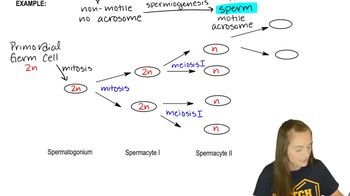
Spermatogenesis
Sequence in testes yielding four motile sperm from diploid germ cells via mitosis, meiosis, and maturation.
Oogenesis
Ovarian process forming one large egg and polar bodies, with developmental pauses and unequal cytoplasmic division.
Primordial Germ Cell
Diploid precursor in gonads acting as a stem cell source for gamete formation in both sexes.
Spermatogonium
Mitotically active diploid cell in testes, derived from germ cells, initiating sperm development.
Primary Spermatocyte
Diploid cell in spermatogenesis entering meiosis I to generate haploid secondary spermatocytes.
Secondary Spermatocyte
Haploid cell formed after meiosis I in males, proceeding to meiosis II to produce spermatids.
Spermatid
Immature, non-motile haploid cell lacking a tail and acrosome, precursor to mature sperm.
Spermiogenesis
Maturation phase transforming spermatids into motile sperm with tails and acrosomes.
Oogonium
Mitotically dividing diploid cell in ovaries, giving rise to primary oocytes before birth.
Primary Oocyte
Diploid cell arrested in prophase I from before birth until ovulation, source of secondary oocyte.
Secondary Oocyte
Large haploid cell produced at ovulation, completing meiosis II only upon fertilization.
Polar Body
Small, haploid byproduct of oogenesis, containing minimal cytoplasm and destined for degradation.
Ovum
Mature, nutrient-rich haploid female gamete, largest human cell, formed after fertilization.
Acrosome
Cap-like structure on sperm head containing enzymes essential for penetrating the egg.
 BackBack

 21:21
21:21