Back

Chromosomal Rearrangements: Translocations definitions

Control buttons has been changed to "navigation" mode.
1/15
  • Translocation

    Movement of a chromosomal segment to a different chromosome, altering gene arrangement and inheritance patterns.
  • Reciprocal Translocation

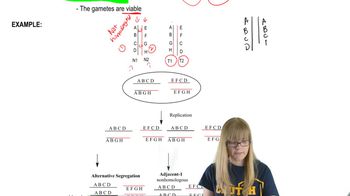
    Exchange of acentric fragments between two non-homologous chromosomes, leading to complex segregation during meiosis.
  • Acentric Fragment

    Chromosomal piece lacking a centromere, often involved in exchanges during certain chromosomal rearrangements.
  • Adjacent-1 Segregation

    Meiotic outcome where non-homologous chromosomes segregate together, producing non-viable gametes due to incomplete gene sets.
  • Adjacent-2 Segregation

    Meiotic outcome where homologous chromosomes segregate together, also resulting in non-viable gametes lacking full genetic content.
  • Alternative Segregation

    Meiotic outcome where either all normal or all translocated chromosomes segregate together, yielding viable gametes with complete genes.
  • Homologous Chromosome

    Chromosome pair containing the same genes, which align during meiosis and influence segregation outcomes.
  • Robertsonian Translocation

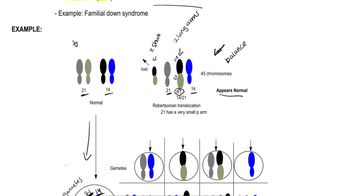
    Fusion of two long arms from non-homologous acrocentric chromosomes, often resulting in a single chromosome and loss of short arms.
  • Acrocentric Chromosome

    Chromosome with a centromere near one end, producing a very short arm and a much longer arm.
  • Balanced Translocation

    Chromosomal rearrangement where all genetic material is present, though rearranged, typically causing no phenotypic effect.
  • Unbalanced Translocation

    Chromosomal rearrangement resulting in extra or missing genetic material, often leading to disorders or non-viable offspring.
  • Familial Down Syndrome

    Genetic condition caused by inheritance of a Robertsonian translocation involving chromosome 21, leading to trisomy 21.
  • Trisomy 21

    Presence of three copies of chromosome 21, resulting in Down syndrome, which can arise from chromosomal rearrangements.
  • Gamete Segregation

    Distribution of chromosomes into reproductive cells during meiosis, determining genetic outcomes in offspring.
  • Chromosomal Aberration

    Structural alteration in chromosomes, such as translocations, that can impact gene dosage and inheritance.