Back

Chromosomal Rearrangements: Inversions quiz

Control buttons has been changed to "navigation" mode.
1/15
  • What is a chromosomal inversion?

    A chromosomal inversion is when a segment of a chromosome is reversed in orientation, but the overall genetic content remains the same.
  • What are the two main types of chromosomal inversions?

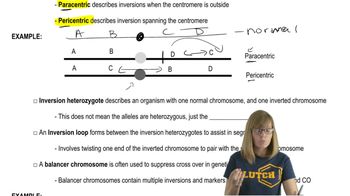
    The two main types are paracentric inversions (which do not include the centromere) and pericentric inversions (which include the centromere).
  • What distinguishes a paracentric inversion from a pericentric inversion?

    A paracentric inversion does not involve the centromere, while a pericentric inversion includes the centromere in the inverted segment.
  • What is an inversion heterozygote?

    An inversion heterozygote is an individual with one normal chromosome and one chromosome with an inversion, either paracentric or pericentric.
  • Does an inversion heterozygote refer to alleles or chromosomes?

    It refers to chromosomes, not alleles; the alleles can be homozygous even if the chromosomes are heterozygous for the inversion.
  • How does an inversion loop form?

    An inversion loop forms when a segment of a chromosome twists and pairs with its uninverted counterpart, allowing the segment to flip orientation.
  • Why do scientists use balancer chromosomes?

    Scientists use balancer chromosomes to suppress crossing over, allowing them to study genes or chromosomes without recombination.
  • What feature do balancer chromosomes have to prevent crossing over?

    Balancer chromosomes contain multiple inversions, which suppress recombination during meiosis.
  • If a chromosome segment ABCD undergoes a paracentric inversion involving CD, what is the new order?

    The new order would be ABDC, with the centromere not included in the inversion.
  • If a chromosome segment ABCD undergoes a pericentric inversion involving BC, what is the new order?

    The new order would be ACBD, with the centromere included in the inverted segment.
  • What does the term 'inversion' specifically refer to in genetics?

    It refers to the reversal of the orientation of a segment within a chromosome.
  • Can all alleles be homozygous in an inversion heterozygote?

    Yes, all alleles can be homozygous even if the chromosomes are heterozygous for the inversion.
  • What is the main purpose of using balancer chromosomes in genetic studies?

    The main purpose is to prevent crossing over, ensuring genetic stability for experimental studies.
  • What does the formation of an inversion loop facilitate?

    It facilitates the flipping of a chromosome segment, leading to the inversion.
  • Why is it important not to confuse inversion heterozygosity with allele heterozygosity?

    Because inversion heterozygosity refers to chromosome structure, not to the presence of different alleles at a gene locus.