Back

Chromosomal Rearrangements: Deletions definitions

Control buttons has been changed to "navigation" mode.
1/14
  • Chromosomal Rearrangement

    Structural alteration of a chromosome, often involving loss, duplication, or reorganization of segments.
  • Double-Stranded Break

    Disruption of both DNA strands, often initiating removal of a chromosome segment.
  • Centromere

    Chromosomal region essential for spindle attachment and proper segregation during cell division.
  • Enterogenic Deletion

    Loss of DNA sequence within a single gene, typically abolishing its function.
  • Multigenic Deletion

    Removal of a chromosomal segment containing multiple genes, impacting several genetic functions.
  • Terminal Deletion

    Loss of the end portion of a chromosome, including all genes distal to the break.
  • Intercalary Deletion

    Elimination of an internal chromosome segment, leaving terminal regions intact.
  • Pseudodominance

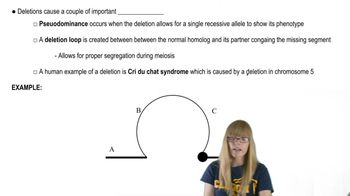
    Phenomenon where a recessive allele expresses its trait due to absence of a dominant allele from deletion.
  • Deletion Loop

    Meiotic structure formed when a normal homolog pairs with a chromosome missing a segment.
  • Meiosis

    Cell division process generating gametes, where proper chromosome pairing and segregation are crucial.
  • Cri du Chat Syndrome

    Genetic disorder from chromosome 5 deletion, causing infants to produce a cat-like cry.
  • Phenotype

    Observable trait or characteristic resulting from genetic makeup and environmental influence.
  • Homolog

    One of a pair of chromosomes carrying the same genes, inherited from each parent.
  • Cell Division

    Biological process where a parent cell splits, distributing genetic material to daughter cells.