Skip to main content
Genetics
My Course
Learn
Exam Prep
AI Tutor
Study Guides
Textbook Solutions
Flashcards
Explore
Try the app
My Course
Learn
Exam Prep
AI Tutor
Study Guides
Textbook Solutions
Flashcards
Explore
Try the app
Back
Bacterial Transformation definitions
You can tap to flip the card.
Transformation
You can tap to flip the card.
👆
Transformation
Uptake of external genetic material by bacteria, enabling new traits or functions, often used in laboratory gene studies.
Track progress
Control buttons has been changed to "navigation" mode.
1/15
Related flashcards
Related practice
Recommended videos
Bacterial Transformation quiz #1
Bacterial Transformation
10 Terms
Bacterial Transformation
5. Genetics of Bacteria and Viruses
7 problems
Topic
Kylia
Bacteriophage Genetics
5. Genetics of Bacteria and Viruses
7 problems
Topic
Kylia
5. Genetics of Bacteria and Viruses
5 topics
13 problems
Chapter
Kylia
Guided course
05:48
Transformation
8
views
1
rank
Terms in this set (15)
Hide definitions
Transformation
Uptake of external genetic material by bacteria, enabling new traits or functions, often used in laboratory gene studies.
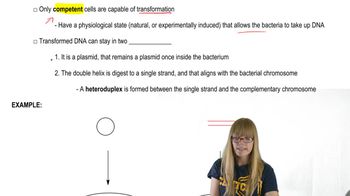
Competent Cells
Bacterial cells in a physiological state that allows them to absorb external DNA through their membrane.
Plasmid
Circular DNA molecule commonly used in experiments for gene expression and protein production in bacteria.
Heteroduplex
DNA structure formed when a single strand aligns with a complementary region on the bacterial chromosome after transformation.
Gene Mapping
Technique using DNA uptake patterns to determine the relative positions of genes on a chromosome.
Fragmented DNA
Pieces of genetic material produced by breaking DNA, used to study gene proximity during transformation.
Double Transformation
Simultaneous uptake of two genes by a bacterium, indicating their close proximity on the original DNA.
Bacterial Membrane
Barrier that external DNA must cross for successful genetic uptake during transformation.
Physiological State
Condition of bacteria, natural or induced, that enables DNA absorption from the environment.
Lysis
Process where a bacterial cell bursts, releasing its DNA into the environment for potential uptake.
Experimental Technique
Laboratory method involving manipulation of bacteria and DNA to study genetic functions or produce proteins.
Chromosome
Large DNA molecule in bacteria where foreign DNA fragments can integrate during transformation.
Complementary Region
Segment of bacterial DNA with a sequence similar enough to align with incoming single-stranded DNA.
Protein Production
Outcome of introducing specific genes into bacteria, leading to synthesis of desired proteins.
Enzyme
Molecule used to fragment DNA, facilitating gene mapping and transformation studies.
 BackBack
 05:48
05:48