Skip to main content
Genetics
My Course
Learn
Exam Prep
AI Tutor
Study Guides
Textbook Solutions
Flashcards
Explore
Try the app
My Course
Learn
Exam Prep
AI Tutor
Study Guides
Textbook Solutions
Flashcards
Explore
Try the app
Back
Bacterial Conjugation definitions
You can tap to flip the card.
Conjugation
You can tap to flip the card.
👆
Conjugation
Physical union of two bacterial cells enabling direct exchange of genetic material through a specialized structure.
Track progress
Control buttons has been changed to "navigation" mode.
1/15
Related flashcards
Related practice
Recommended videos
Bacterial Conjugation quiz #1
Bacterial Conjugation
10 Terms
Bacterial Conjugation
5. Genetics of Bacteria and Viruses
7 problems
Topic
Kylia
Bacterial Transformation
5. Genetics of Bacteria and Viruses
7 problems
Topic
Kylia
5. Genetics of Bacteria and Viruses
5 topics
13 problems
Chapter
Kylia
Guided course
04:06
Conjugation Overview
10
views
Guided course
08:52
F Factor and Hfr
10
views
Guided course
02:19
R Plasmid
10
views
Terms in this set (15)
Hide definitions
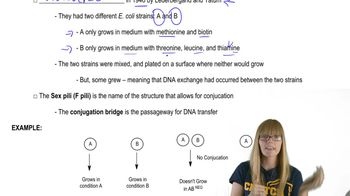
Conjugation
Physical union of two bacterial cells enabling direct exchange of genetic material through a specialized structure.
Sex Pilus
Surface appendage produced by donor bacteria, facilitating attachment and DNA transfer during cell-to-cell contact.
Conjugation Bridge
Temporary passageway formed between two bacteria, allowing movement of DNA from donor to recipient.
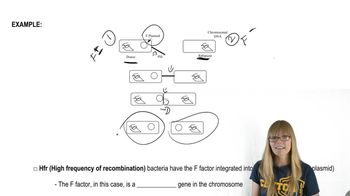
F Factor
Circular DNA element granting bacteria the ability to initiate genetic exchange and form donor cells.
F+ Cell
Bacterial cell containing a specific plasmid, capable of donating genetic material during conjugation.
F- Cell
Bacterial cell lacking a particular plasmid, functioning as a recipient during genetic exchange.
Plasmid
Small, circular DNA molecule independent of the main chromosome, often carrying advantageous genes.
HFR Cell
Bacterial cell with a genetic element integrated into its chromosome, enabling high-frequency recombination.
Genetic Recombination
Process resulting in new gene combinations, often through integration of transferred DNA into the chromosome.
Interrupted Mating
Experimental technique halting DNA transfer between bacteria to determine gene order and proximity.
Origin
Specific chromosomal site where DNA transfer initiates during high-frequency recombination events.
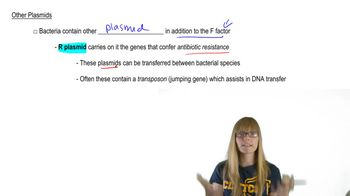
R Plasmid
Mobile genetic element conferring antibiotic resistance, capable of spreading between diverse bacterial species.
Antibiotic Resistance
Trait enabling bacteria to survive and proliferate despite the presence of antimicrobial agents.
Transposon
Segment of DNA capable of moving within or between genomes, facilitating gene transfer and variability.
Recombinant
Bacterial cell with a new genetic makeup resulting from the integration of foreign DNA.
 BackBack
 04:06
04:06