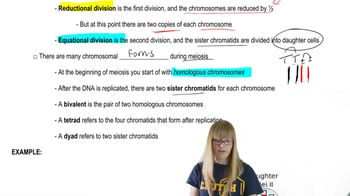
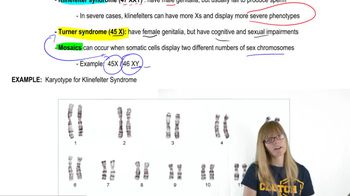
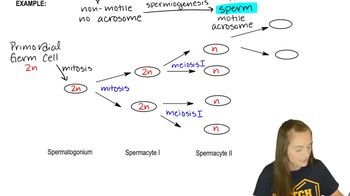
Assume that you were examining a first polar body and noted that it had one copy (dyad) of each chromosome except chromosome 21. Chromosome 21 was completely absent. What would you expect to be the chromosome 21 complement (only with respect to chromosome 21) in the secondary oocyte? What consequences are likely in the resulting zygote if the secondary oocyte was fertilized?

Kuliev and Verlinsky (2004) state that there was a relatively high number of separation errors at meiosis I. In these cases the centromere underwent a premature division, occurring at meiosis I rather than meiosis II. Regarding chromosome 21, what would you expect to be the chromosome 21 complement in the secondary oocyte in which you saw a single chromatid (monad) for chromosome 21 in the first polar body? If this secondary oocyte was involved in fertilization, what would be the expected consequences?
Verified step by step guidance
Verified video answer for a similar problem:
Key Concepts
Meiosis and Chromosome Segregation
Chromosome 21 and Down Syndrome
Polar Bodies and Oocyte Development
An interesting procedure has been applied for assessing the chromosomal balance of potential secondary oocytes for use in human in vitro fertilization. Using fluorescence in situ hybridization (FISH), Kuliev and Verlinsky (2004) were able to identify individual chromosomes in first polar bodies and thereby infer the chromosomal makeup of 'sister' oocytes. Assume that when examining a first polar body you saw that it had one copy (dyad) of each chromosome but two dyads of chromosome 21. What would you expect to be the chromosomal 21 complement in the secondary oocyte? What consequences are likely in the resulting zygote, if the secondary oocyte was fertilized?
A species of cereal rye (Secale cereale) has a chromosome number of 14, while a species of Canadian wild rye (Elymus canadensis) has a chromosome number of 28. Sterile hybrids can be produced by crossing Secale with Elymus.
Given that none of the chromosomes pair at meiosis I in the sterile hybrid (Hang and Franckowlak, 1984), speculate on the anaphase I separation patterns of these chromosomes.
