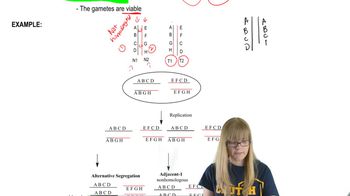
An animal heterozygous for a reciprocal balanced translocation has the following chromosomes:
MN • OPQRST
MN • OPQRjkl
cdef • ghijkl
cdef • ghiST
Identify the gametes produced by alternate segregation. Which, if any, of these gametes are viable?

Sanders 3rd Edition
Ch. 10 - Eukaryotic Chromosome Abnormalities and Molecular Organization
Problem 13c
Verified step by step guidance
An animal heterozygous for a reciprocal balanced translocation has the following chromosomes:
MN • OPQRST
MN • OPQRjkl
cdef • ghijkl
cdef • ghiST
Identify the gametes produced by alternate segregation. Which, if any, of these gametes are viable?
An animal heterozygous for a reciprocal balanced translocation has the following chromosomes:
MN • OPQRST
MN • OPQRjkl
cdef • ghijkl
cdef • ghiST
Identify the gametes produced by adjacent-2 segregation. Which if any of these gametes are viable?
An animal heterozygous for a reciprocal balanced translocation has the following chromosomes:
MN • OPQRST
MN • OPQRjkl
cdef • ghijkl
cdef • ghiST
Diagram the pairing of these chromosomes in prophase I.
An animal heterozygous for a reciprocal balanced translocation has the following chromosomes:
MN • OPQRST
MN • OPQRjkl
cdef • ghijkl
cdef • ghiST
Among the three segregation patterns, which is least likely to occur? Why?
Dr. Ara B. Dopsis has an idea he thinks will be a boon to agriculture. He wants to create the 'pomato,' a hybrid between a tomato (Lycopersicon esculentum) that has 12 chromosomes and a potato (Solanum tuberosum) that has 48 chromosomes. Dr. Dopsis is hoping his new pomato will have tuber growth like a potato and the fruit production of a tomato. He joins a haploid gamete from each species to form a hybrid and then induces doubling of chromosome number. How many chromosomes will the hybrid have before chromosome doubling?
A pair of homologous chromosomes in Drosophila has the following content (single letters represent genes):
Chromosome 1RNMDHBGKWU
Chromosome 2RNMDHBDHBGKWU
How does the pairing diagrammed in part (b) differ from the pairing of chromosomes in an inversion heterozygote?