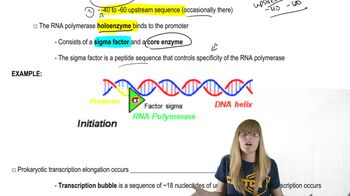
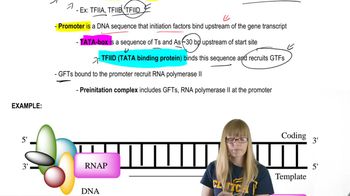
The DNA sequences shown below are from the promoter regions of six bacterial genes. In each case, the last nucleotide in the sequence (highlighted in blue) is the nucleotide that initiates transcription. Determine the consensus sequence for the Pribnow box from these sequences.

Sanders 3rd Edition
Ch. 8 - Molecular Biology of Transcription and RNA Processing
Problem 9Describe the two types of transcription termination found in bacterial genes. How does transcription termination differ for eukaryotic genes?
Verified step by step guidance
Verified video answer for a similar problem:
Key Concepts
Transcription Termination in Bacteria
Eukaryotic Transcription Termination
Differences Between Prokaryotic and Eukaryotic Termination
What is the role of enhancer sequences in transcription of eukaryotic genes? Speculate about why enhancers are not part of transcription of bacterial genes.
Draw a bacterial promoter and label its consensus sequences. How does this promoter differ from a eukaryotic promoter transcribed:
By RNA polymerase II?
By RNA polymerase I?
By RNA polymerase III?
Bacterial and eukaryotic gene transcripts can differ—in the transcripts themselves, in whether the transcripts are modified before translation, and in how the transcripts are modified. For each of these three areas of contrast, describe what the differences are and why the differences exist.
Describe the difference between introns and exons.
The DNA sequences shown below are from the promoter regions of six bacterial genes. In each case, the last nucleotide in the sequence (highlighted in blue) is the nucleotide that initiates transcription. Examine these sequences and identify the Pribnow box sequence at approximately -10 for each promoter.