Ch.22 - Organic Chemistry
Tro - Chemistry: A Molecular Approach 6th Edition
Tro6th EditionChemistry: A Molecular ApproachISBN: 9780137832217Not the one you use?Change textbook
Chapter 22, Problem 84a

Determine the products of each carboxylic acid reaction. a.
Chemical reaction of a carboxylic acid with sodium hydroxide in organic chemistry.

Verified step by step guidance
1
Identify the functional groups in the reactants. Here, we have a carboxylic acid (R-COOH) and sodium hydroxide (NaOH).
Recognize that carboxylic acids react with bases to form a salt and water. This is a neutralization reaction.
Write the general reaction for a carboxylic acid with a base: R-COOH + NaOH -> R-COONa + H2O.
Apply the general reaction to the specific reactants given: CH3CH2CH2COOH + NaOH -> CH3CH2CH2COONa + H2O.
Identify the products: the sodium salt of the carboxylic acid (butanoate) and water.

Verified video answer for a similar problem:

This video solution was recommended by our tutors as helpful for the problem above.
Video duration:
1m

Key Concepts

Here are the essential concepts you must grasp in order to answer the question correctly.

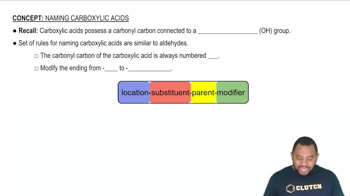
Carboxylic Acids

Carboxylic acids are organic compounds characterized by the presence of a carboxyl group (-COOH). They are known for their acidic properties due to the ability of the carboxyl group to donate a proton (H+) in solution. This functional group is crucial in various chemical reactions, including esterification and neutralization with bases.
Recommended video:
Guided course
00:55
Rules for Naming Carboxylic Acids

Neutralization Reaction

A neutralization reaction occurs when an acid reacts with a base to produce water and a salt. In this case, the carboxylic acid reacts with sodium hydroxide (NaOH), a strong base, resulting in the formation of a salt (sodium carboxylate) and water. This type of reaction is fundamental in acid-base chemistry and is often used in titrations.
Recommended video:
Guided course
05:56
Lewis Dot Structures: Neutral Compounds

Sodium Hydroxide (NaOH)

Sodium hydroxide is a strong base commonly used in various chemical reactions, including neutralization and saponification. It dissociates completely in water to produce hydroxide ions (OH-), which can react with acids to form water and a salt. Understanding its role in reactions with carboxylic acids is essential for predicting the products of such reactions.
Recommended video:
Guided course
06:12
Hydroxide Ion Concentration Example