How important is the resonance structure shown here to the overall structure of carbon dioxide? Explain.

Ch.10 - Chemical Bonding I: The Lewis Model

Chapter 10, Problem 70
Use formal charges to identify the better Lewis structure.
Verified step by step guidance1
Step 1: Draw the Lewis structures for the molecule or ion. Remember that Lewis structures are based on the concept that shared or bonding electrons come from the atomic orbitals of the bonded atoms. A Lewis structure also helps to make a prediction on the molecular geometry of the molecule.
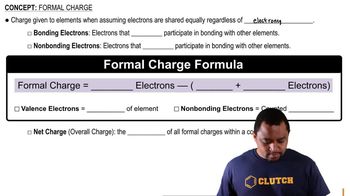
Step 2: Calculate the formal charge for each atom in the Lewis structure. The formal charge of an atom in a molecule is the hypothetical charge the atom would have if we could redistribute the electrons in the bonds evenly between the atoms. The formula to calculate the formal charge is: Formal Charge = [# of valence electrons on atom] - [non-bonded electrons + number of bonds].
Step 3: Compare the formal charges with the actual charges on the atoms. The Lewis structure that has the charges closest to zero is typically the most stable. Also, any negative charges should reside on the more electronegative atoms.
Step 4: If the formal charges are not equal, the structure with the smallest formal charges (closest to zero) is usually the correct one. If the formal charges are equal, the structure with the negative formal charges on the most electronegative atom is preferred.
Step 5: Remember that the best Lewis structure is the one that has the minimum formal charges on the atoms, and those charges should match the actual charge of the molecule or ion. If multiple structures are possible, the structure with the least formal charge is the best.

Verified video answer for a similar problem:
This video solution was recommended by our tutors as helpful for the problem above.
Video duration:
7mWas this helpful?
Key Concepts
Here are the essential concepts you must grasp in order to answer the question correctly.
Lewis Structures
Lewis structures are diagrams that represent the bonding between atoms in a molecule and the lone pairs of electrons that may exist. They use dots to represent valence electrons and lines to represent bonds between atoms. Understanding how to draw and interpret Lewis structures is essential for visualizing molecular geometry and predicting reactivity.
Recommended video:
Guided course
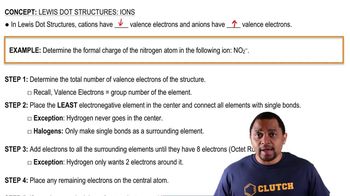
Lewis Dot Structures: Ions
Formal Charge
Formal charge is a theoretical charge assigned to an atom in a molecule, calculated based on the number of valence electrons, the number of non-bonding electrons, and the number of bonds. It helps in determining the most stable Lewis structure by minimizing the formal charges across the molecule. A structure with the lowest formal charges is generally preferred, as it indicates a more stable arrangement of electrons.
Recommended video:
Guided course
Formal Charge
Resonance Structures
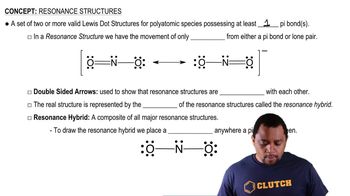
Resonance structures are different Lewis structures that represent the same molecule, differing only in the arrangement of electrons. They are used when a single Lewis structure cannot adequately depict the actual distribution of electrons. The true structure is a hybrid of these resonance forms, and understanding resonance is crucial for accurately predicting molecular behavior and stability.
Recommended video:
Guided course
Resonance Structures
Related Practice
Textbook Question
Textbook Question
In N2O, nitrogen is the central atom and the oxygen atom is terminal. In OF2, however, oxygen is the central atom. Use formal charges to explain why.
1
views
Textbook Question
Write a Lewis structure that obeys the octet rule for each molecule or ion. Include resonance structures if necessary and assign formal charges to each atom. a. SeO2
Textbook Question
Draw the Lewis structure (including resonance structures) for the acetate ion (CH3COO-). For each resonance structure, assign formal charges to all atoms that have formal charge.
Textbook Question
Write a Lewis structure that obeys the octet rule for each ion. Include resonance structures if necessary and assign formal charges to each atom. a. ClO3- b. ClO4- c. NO3- d. NH4+
Textbook Question
Write the Lewis structure for each molecule or ion. a. H3COCH3