
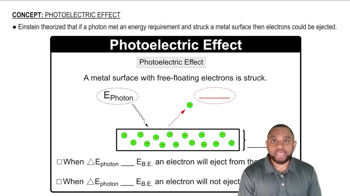

Ionization involves completely removing an electron from an atom. How much energy is required to ionize a hydrogen atom in its ground (or lowest energy) state? What wavelength of light contains enough energy in a single photon to ionize a hydrogen atom?

An X-ray photon of wavelength 0.989 nm strikes a surface. The emitted electron has a kinetic energy of 969 eV. What is the binding energy of the electron in kJ/mol? [KE = 1/2 mv2; 1 electron volt (eV) = 1.602×10⁻¹⁹ J]
Verified step by step guidance
Verified video answer for a similar problem:
Key Concepts
Photoelectric Effect
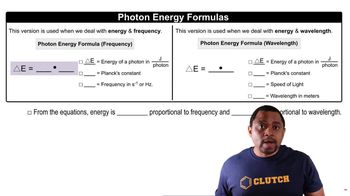
Energy of a Photon
Conversion of Energy Units
The energy required to ionize sodium is 496 kJ/mol. What minimum frequency of light is required to ionize sodium?
Suppose that in an alternate universe, the possible values of l are the integer values from 0 to n (instead of 0 to n - 1). Assuming no other differences between this imaginary universe and ours, how many orbitals would exist in each level? a. n = 1 b. n = 2 c. n = 3
An argon ion laser puts out 5.0 W of continuous power at a wavelength of 532 nm. The diameter of the laser beam is 5.5 mm. If the laser is pointed toward a pinhole with a diameter of 1.2 mm, how many photons travel through the pinhole per second? Assume that the light intensity is equally distributed throughout the entire cross-sectional area of the beam. (1 W = 1 J/s)
