The average human lung expands by about 0.50 L during each breath. If this expansion occurs against an external pressure of 1.0 atm, how much work (in J) is done during the expansion?

Ch.7 - Thermochemistry

Chapter 7, Problem 52
An unknown mass of each substance, initially at 23.0 °C, absorbs 1.95 × 10³ J of heat. The final temperature is recorded. Find the mass of each substance.
a. Pyrex glass (Tf = 55.4°C)
b. sand (Tf = 62.1°C)
c. ethanol (Tf = 44.2°C)
d. water (Tf = 32.4°C)
Verified step by step guidance1
Identify the specific heat capacity of Pyrex glass, which is typically around 0.75 J/g°C.
Use the formula for heat transfer: \( q = m \cdot c \cdot \Delta T \), where \( q \) is the heat absorbed, \( m \) is the mass, \( c \) is the specific heat capacity, and \( \Delta T \) is the change in temperature.
Calculate the change in temperature \( \Delta T \) using the initial and final temperatures: \( \Delta T = T_f - T_i = 55.4 \text{ °C} - 23.0 \text{ °C} \).
Rearrange the formula to solve for mass \( m \): \( m = \frac{q}{c \cdot \Delta T} \).
Substitute the known values into the rearranged formula: \( q = 1.95 \times 10^3 \text{ J} \), \( c = 0.75 \text{ J/g°C} \), and \( \Delta T \) calculated in the previous step, to find the mass \( m \).

Verified video answer for a similar problem:
This video solution was recommended by our tutors as helpful for the problem above.
Video duration:
1mWas this helpful?
Key Concepts
Here are the essential concepts you must grasp in order to answer the question correctly.
Specific Heat Capacity
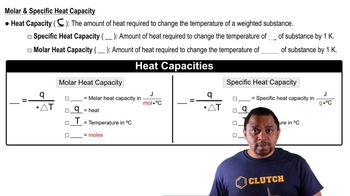
Specific heat capacity is the amount of heat required to raise the temperature of one gram of a substance by one degree Celsius. It varies for different materials and is crucial for calculating temperature changes when heat is absorbed or released. In this problem, knowing the specific heat capacity of Pyrex glass allows us to relate the heat absorbed to the change in temperature and ultimately find the mass.
Recommended video:
Guided course
Heat Capacity
Heat Transfer Equation
The heat transfer equation, often expressed as Q = mcΔT, relates the heat absorbed or released (Q) to the mass (m), specific heat capacity (c), and the change in temperature (ΔT). This equation is fundamental in thermodynamics and is used to solve for unknown variables, such as mass, when heat transfer is involved. In this case, it will help determine the mass of the Pyrex glass based on the heat absorbed and the temperature change.
Recommended video:
Guided course
Heat Capacity
Temperature Change
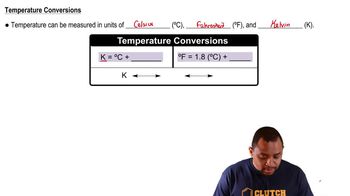
Temperature change (ΔT) is the difference between the final temperature (Tf) and the initial temperature (Ti) of a substance. It is a critical factor in thermodynamic calculations, as it directly influences the amount of heat absorbed or released. In this scenario, the temperature change of the Pyrex glass from 23.0 °C to 55.4 °C is essential for applying the heat transfer equation to find the mass of the substance.
Recommended video:
Guided course
Temperature Conversion Formulas
Related Practice
Textbook Question
Textbook Question
The air within a piston equipped with a cylinder absorbs 565 J of heat and expands from an initial volume of 0.10 L to a final volume of 0.85 L against an external pressure of 1.0 atm. What is the change in internal energy of the air within the piston?
9
views
Textbook Question
How much heat is required to warm 2.50 L of water from 25.0 °C to 100.0 °C? (Assume a density of 1.0 g/mL for the water.)
Textbook Question
How much heat is required to warm 2.50 kg of sand from 25.0 °C to 100.0 °C?
Textbook Question
How much work (in J) is required to expand the volume of a pump from 0.0 L to 2.5 L against an external pressure of 1.1 atm?
Textbook Question
Suppose that 25 g of each substance is initially at 27.0 °C. What is the final temperature of each substance upon absorbing 2.35 kJ of heat? c. aluminum
1
views