
We pack two identical coolers for a picnic, placing 24 12-ounce soft drinks and five pounds of ice in each. However, the drinks that we put into cooler A were refrigerated for several hours before they were packed in the cooler, while the drinks that we put into cooler B were at room temperature. When we open the two coolers three hours later, most of the ice in cooler A is still present, while nearly all of the ice in cooler B has melted. Explain this difference.
Ch.7 - Thermochemistry

Chapter 7, Problem 48
A kilogram of aluminum metal and a kilogram of water are each warmed to 75 °C and placed in two identical insulated containers. One hour later, the two containers are opened and the temperature of each substance is measured. The aluminum has cooled to 35 °C, while the water has cooled only to 66 °C. Explain this difference.
Verified step by step guidance1
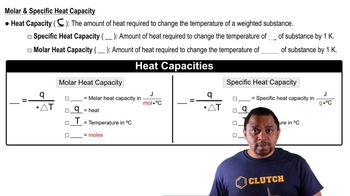
Understand the concept of specific heat capacity, which is the amount of heat required to raise the temperature of one kilogram of a substance by one degree Celsius. Different substances have different specific heat capacities.
Recognize that aluminum and water have different specific heat capacities. Water has a higher specific heat capacity than aluminum, meaning it can store more heat energy per kilogram per degree Celsius than aluminum.
Consider the initial conditions where both aluminum and water are heated to the same temperature. Despite being at the same temperature, the water, with its higher specific heat capacity, contains more total heat energy than the aluminum.
Analyze the cooling process in the insulated containers. Since water has a higher specific heat capacity, it releases heat more slowly than aluminum. This slower rate of heat loss results in a higher temperature compared to aluminum after one hour.
Conclude that the difference in temperature after cooling is due to the higher specific heat capacity of water compared to aluminum, which makes water retain heat longer and cool down at a slower rate.

Verified video answer for a similar problem:
This video solution was recommended by our tutors as helpful for the problem above.
Video duration:
34sWas this helpful?
Key Concepts
Here are the essential concepts you must grasp in order to answer the question correctly.
Specific Heat Capacity
Specific heat capacity is the amount of heat required to raise the temperature of one gram of a substance by one degree Celsius. Different materials have different specific heat capacities, which affects how they absorb and release heat. Water has a high specific heat capacity (4.18 J/g°C), meaning it can absorb a lot of heat without a significant change in temperature, while aluminum has a lower specific heat capacity (0.897 J/g°C), leading to a quicker temperature change.
Recommended video:
Guided course
Heat Capacity
Thermal Equilibrium
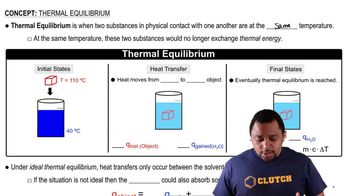
Thermal equilibrium occurs when two substances at different temperatures are in contact, and heat flows from the hotter substance to the cooler one until they reach the same temperature. In this scenario, the aluminum and water started at the same temperature but have different cooling rates due to their specific heat capacities, resulting in different final temperatures after one hour.
Recommended video:
Guided course
Thermal Equilibrium
Insulation and Heat Loss
Insulation refers to materials that reduce the rate of heat transfer between substances. In this experiment, the insulated containers minimize heat loss to the environment, allowing for a more accurate comparison of how the two substances cool. The difference in final temperatures is primarily due to the inherent properties of aluminum and water, rather than external heat loss.
Recommended video:
Guided course
Heat Capacity
Related Practice
Textbook Question
1
views
Textbook Question
How much heat is required to warm 2.50 L of water from 25.0 °C to 100.0 °C? (Assume a density of 1.0 g/mL for the water.)
Textbook Question
The air in an inflated balloon (defined as the system) warms over a toaster and absorbs 142 J of heat. As it expands, it does 46 kJ of work. What is the change in internal energy for the system?
1
views
Textbook Question
How much heat is required to warm 2.50 kg of sand from 25.0 °C to 100.0 °C?
Textbook Question
Suppose that 25 g of each substance is initially at 27.0 °C. What is the final temperature of each substance upon absorbing 2.35 kJ of heat? c. aluminum
1
views
Textbook Question
A system absorbs 225 kJ of heat and the surroundings do 121 kJ of work on the system. What is the change in internal energy of the system?
