
Hard water often contains dissolved Ca2+ and Mg2+ ions. One way to soften water is to add phosphates. The phosphate ion forms insoluble precipitates with calcium and magnesium ions, removing them from solution. A solution is 0.050 M in calcium chloride and 0.085 M in magnesium nitrate. What mass of sodium phosphate would you add to 1.5 L of this solution to completely eliminate the hard water ions? Assume complete reaction.
Ch.5 - Introduction to Solutions and Aqueous Solutions

Chapter 5, Problem 87d
Predict the products and write a balanced molecular equation for each reaction. If no reaction occurs, write 'NO REACTION.' d. aqueous ammonium chloride and aqueous calcium hydroxide
Verified step by step guidance1
Identify the reactants: Ammonium chloride (NH₄Cl) and calcium hydroxide (Ca(OH)₂).
Determine the possible products by considering the exchange of ions: Ammonium ions (NH₄⁺) can pair with hydroxide ions (OH⁻) to form water and ammonia gas, while calcium ions (Ca²⁺) can pair with chloride ions (Cl⁻) to form calcium chloride (CaCl₂).
Write the unbalanced molecular equation: NH₄Cl(aq) + Ca(OH)₂(aq) → NH₃(g) + H₂O(l) + CaCl₂(aq).
Balance the chemical equation by ensuring the same number of each type of atom on both sides of the equation.
Check the solubility of the products to confirm the reaction: Ammonia gas (NH₃) and water (H₂O) are formed, and calcium chloride (CaCl₂) is soluble in water, indicating that a reaction occurs.

Verified video answer for a similar problem:
This video solution was recommended by our tutors as helpful for the problem above.
Video duration:
1mWas this helpful?
Key Concepts
Here are the essential concepts you must grasp in order to answer the question correctly.
Double Displacement Reaction
A double displacement reaction, also known as a metathesis reaction, occurs when two compounds exchange ions to form new compounds. In this type of reaction, the cations and anions of the reactants switch partners, typically resulting in the formation of a precipitate, gas, or water. Understanding this concept is crucial for predicting the products of the reaction between ammonium chloride and calcium hydroxide.
Recommended video:
Guided course
Single Displacement Reactions
Solubility Rules
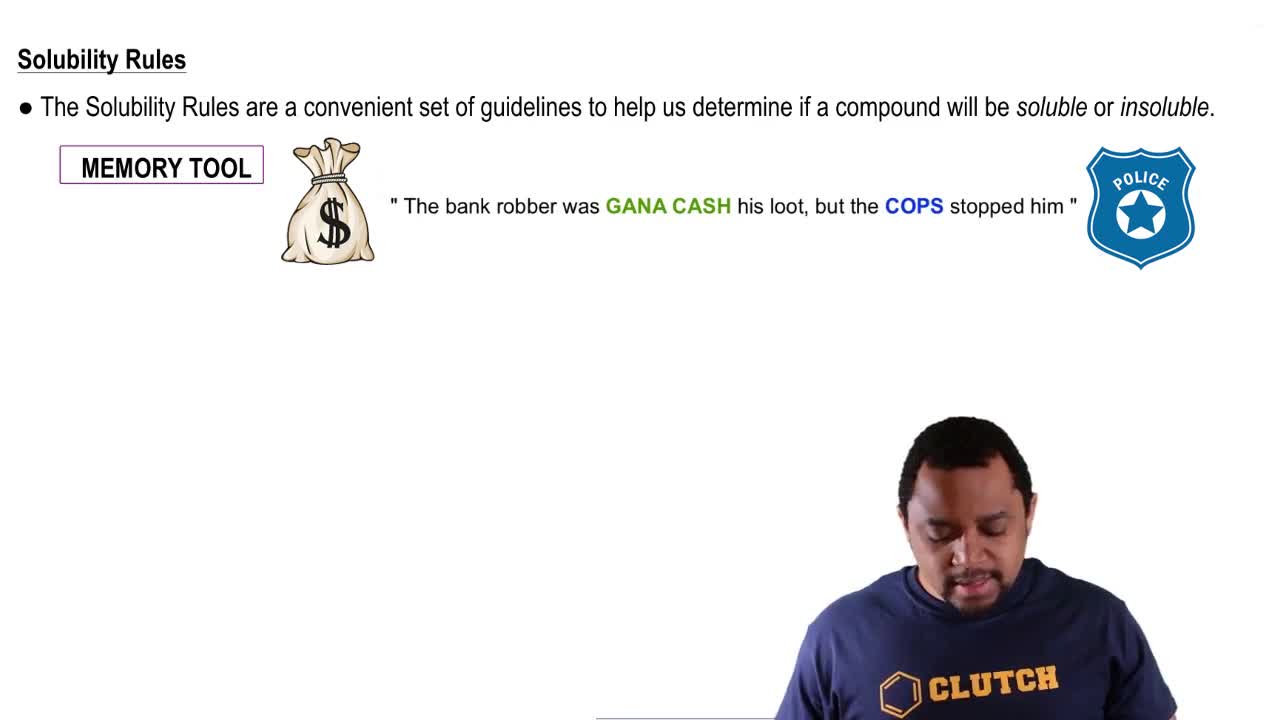
Solubility rules are guidelines that help predict whether a compound will dissolve in water or form a precipitate. These rules indicate which ions are soluble or insoluble in aqueous solutions. For the reaction in question, knowing the solubility of ammonium chloride and calcium hydroxide will help determine if a reaction occurs and what products are formed.
Recommended video:
Guided course
Solubility Rules
Balancing Chemical Equations
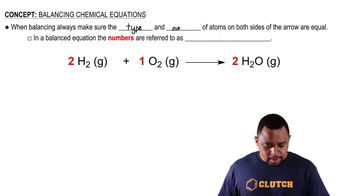
Balancing chemical equations is the process of ensuring that the number of atoms for each element is the same on both sides of the equation. This is essential for obeying the law of conservation of mass, which states that matter cannot be created or destroyed in a chemical reaction. A balanced equation accurately represents the stoichiometry of the reaction, allowing for the correct prediction of products and reactants.
Recommended video:
Guided course
Balancing Chemical Equations
Related Practice
Textbook Question
1
views
Textbook Question
Predict the products and write a balanced molecular equation for each reaction. If no reaction occurs, write 'NO REACTION.' c. liquid pentanol (C5H12O) and gaseous oxygen
Textbook Question
Predict the products and write a balanced molecular equation for each reaction. If no reaction occurs, write 'NO REACTION.' a. HCl(aq) + Hg2(NO3)2(aq) →
3
views
Textbook Question
Find the percent by mass of sodium chloride in a 1.12 M NaCl solution. The density of the solution is 1.04 g/mL.
Textbook Question
Predict the products and write a balanced molecular equation for each reaction. If no reaction occurs, write 'NO REACTION.' b. Cr(NO3)3(aq) + LiOH(aq) →
2
views
