A sample of nitrogen gas in a 1.75-L container exerts a pressure of 1.35 atm at 25 °C. What is the pressure if the volume of the container is maintained constant and the temperature is raised to 355 °C?

Ch.6 - Gases

Chapter 6, Problem 55a
Write balanced complete ionic and net ionic equations for each reaction. a. HCl(aq) + LiOH(aq) → H2O(l) + LiCl(aq)
Verified step by step guidance1
Identify the reactants and products in the given chemical equation: HCl(aq) + LiOH(aq) \(\rightarrow\) H_2O(l) + LiCl(aq).
Write the balanced molecular equation: HCl(aq) + LiOH(aq) \(\rightarrow\) H_2O(l) + LiCl(aq).
Write the complete ionic equation by separating all strong electrolytes into their ions: H^+(aq) + Cl^-(aq) + Li^+(aq) + OH^-(aq) \(\rightarrow\) H_2O(l) + Li^+(aq) + Cl^-(aq).
Identify and cancel out the spectator ions, which appear on both sides of the complete ionic equation: Li^+(aq) and Cl^-(aq).
Write the net ionic equation by including only the ions and molecules directly involved in the reaction: H^+(aq) + OH^-(aq) \(\rightarrow\) H_2O(l).

Verified video answer for a similar problem:
This video solution was recommended by our tutors as helpful for the problem above.
Was this helpful?
Key Concepts
Here are the essential concepts you must grasp in order to answer the question correctly.
Complete Ionic Equation
A complete ionic equation represents all the ions present in a solution during a chemical reaction. It shows the reactants and products in their ionic forms, highlighting the dissociation of soluble ionic compounds in aqueous solutions. This equation is essential for understanding how ions interact in solution and sets the stage for identifying the net ionic equation.
Recommended video:
Guided course
Complete Ionic Equations
Net Ionic Equation
The net ionic equation simplifies the complete ionic equation by removing spectator ions—ions that do not participate in the actual chemical reaction. This equation focuses solely on the species that undergo a change, providing a clearer picture of the chemical process. It is particularly useful for emphasizing the essential components of a reaction and understanding the underlying chemistry.
Recommended video:
Guided course
Net Ionic Equations
Acid-Base Neutralization Reaction
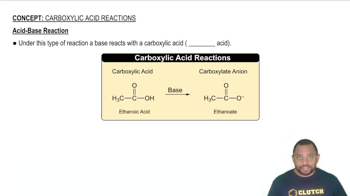
An acid-base neutralization reaction occurs when an acid reacts with a base to produce water and a salt. In the given reaction, hydrochloric acid (HCl) reacts with lithium hydroxide (LiOH), resulting in the formation of water (H2O) and lithium chloride (LiCl). Understanding this type of reaction is crucial for predicting the products and writing the corresponding ionic equations.
Recommended video:
Guided course
Acid-Base Reaction
Related Practice
Textbook Question
Textbook Question
This picture represents a sample of gas at a pressure of 1 atm, a volume of 1 L, and a temperature of 25 °C. Draw a similar picture showing what would happen to the sample if the volume were reduced to 0.5 L and the temperature were increased to 250 °C. What would happen to the pressure?
Textbook Question
Which gas sample has the greatest pressure? Assume that all the samples are at the same temperature. Explain.
Textbook Question
Aerosol cans carry clear warnings against incineration because of the high pressures that can develop upon heating. Suppose that a can contains a residual amount of gas at a pressure of 755 mmHg and a temperature of 25 °C. What would the pressure be if the can were heated to 1155 °C?
1
views