A syringe containing 1.55 mL of oxygen gas is cooled from 95.3 °C to 0.0 °C. What is the final volume of oxygen gas?
Ch.6 - Gases

Chapter 6, Problem 34
A sample of gas has an initial volume of 14.1 L at a pressure of 1.05 atm. If the sample is compressed to a volume of 10.1 L (at constant temperature), what is its pressure?
Verified step by step guidance1
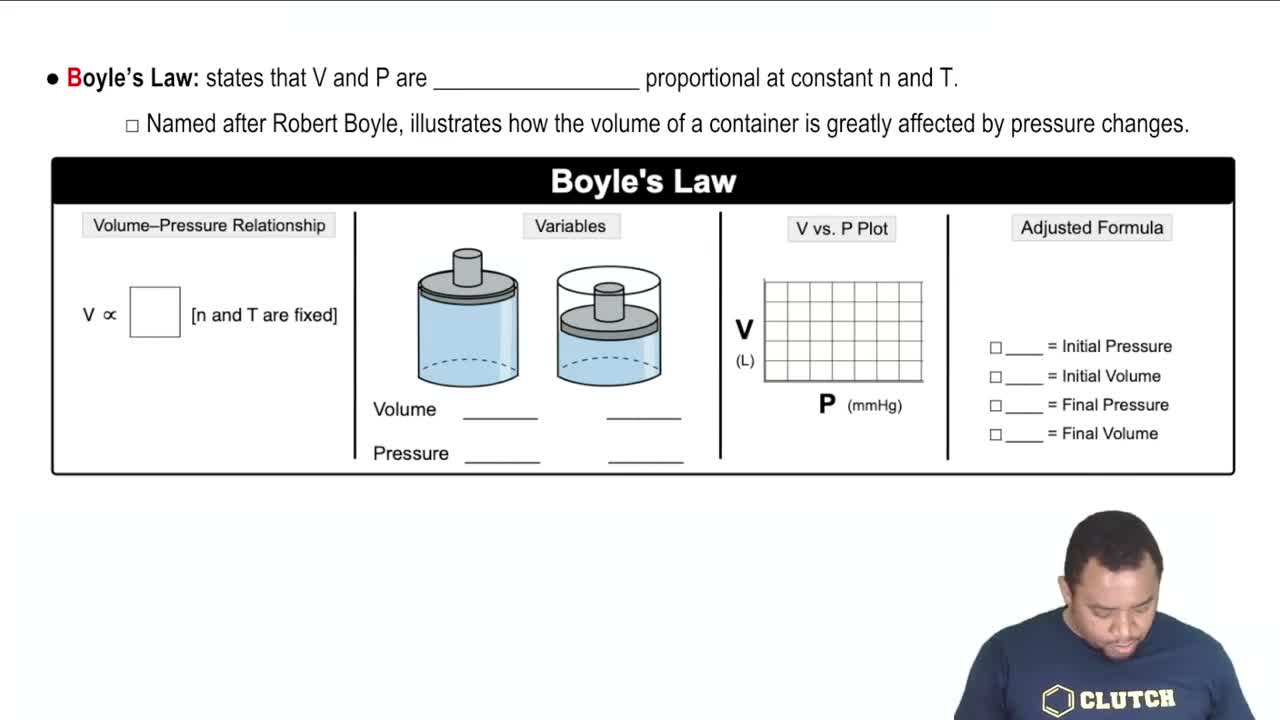
Identify the gas law applicable to the problem. Since the temperature is constant, use Boyle's Law, which states that \( P_1V_1 = P_2V_2 \).
List the known values: initial volume \( V_1 = 14.1 \text{ L} \), initial pressure \( P_1 = 1.05 \text{ atm} \), and final volume \( V_2 = 10.1 \text{ L} \).
Rearrange Boyle's Law to solve for the final pressure \( P_2 \): \( P_2 = \frac{P_1V_1}{V_2} \).
Substitute the known values into the equation: \( P_2 = \frac{1.05 \text{ atm} \times 14.1 \text{ L}}{10.1 \text{ L}} \).
Calculate the expression to find the final pressure \( P_2 \).

Verified video answer for a similar problem:
This video solution was recommended by our tutors as helpful for the problem above.
Video duration:
1mWas this helpful?
Key Concepts
Here are the essential concepts you must grasp in order to answer the question correctly.
Boyle's Law
Boyle's Law states that the pressure of a gas is inversely proportional to its volume when the temperature is held constant. This means that if the volume decreases, the pressure increases, and vice versa. Mathematically, it can be expressed as P1V1 = P2V2, where P1 and V1 are the initial pressure and volume, and P2 and V2 are the final pressure and volume.
Recommended video:
Guided course
Boyle's Law
Ideal Gas Law
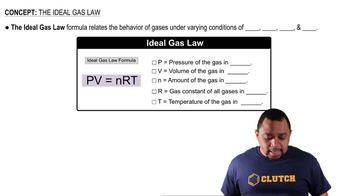
The Ideal Gas Law relates the pressure, volume, temperature, and number of moles of a gas through the equation PV = nRT. While this question specifically uses Boyle's Law, understanding the Ideal Gas Law provides a broader context for gas behavior under various conditions, including how changes in one variable affect others.
Recommended video:
Guided course
Ideal Gas Law Formula
Units of Pressure
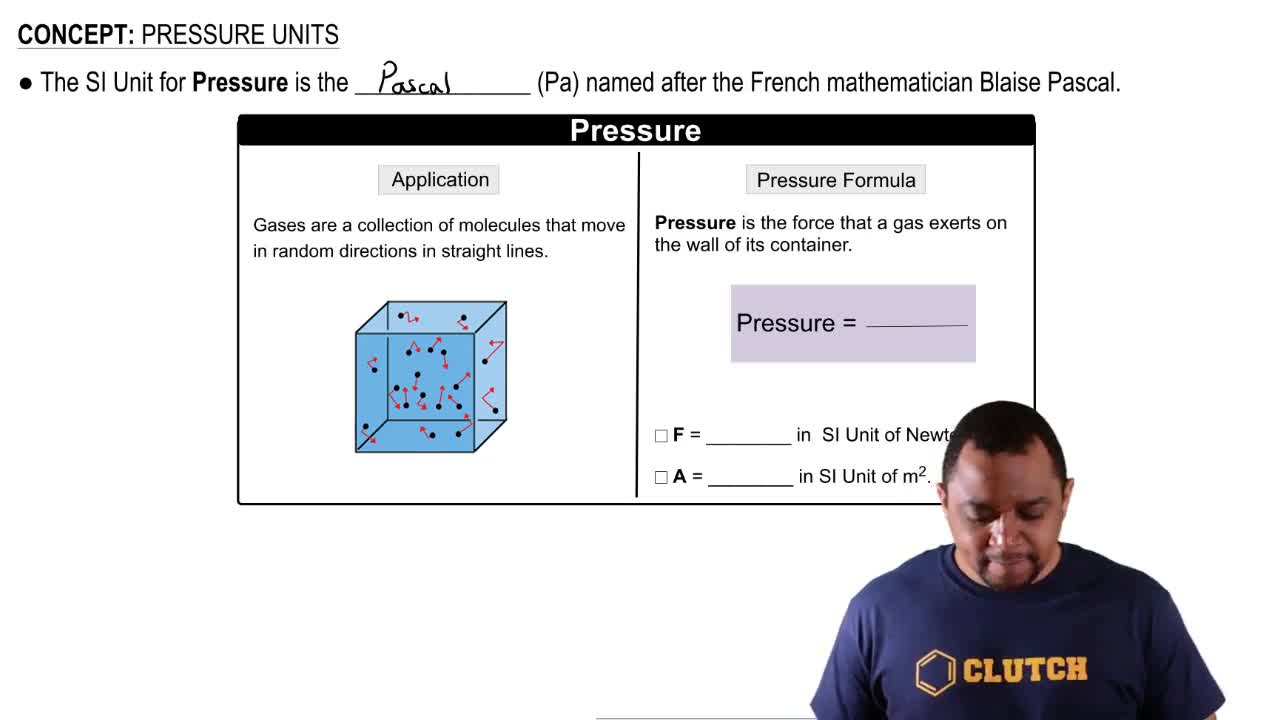
Pressure is commonly measured in units such as atmospheres (atm), pascals (Pa), or millimeters of mercury (mmHg). In this question, pressure is given in atmospheres, which is a standard unit in gas law calculations. Understanding how to convert between these units can be crucial when solving problems involving gas behavior.
Recommended video:
Guided course
Pressure Units
Related Practice
Textbook Question
2
views
Textbook Question
Given a barometric pressure of 751.5 mmHg, calculate the pressure of each gas sample as indicated by the manometer.
(a)
Textbook Question
Given a barometric pressure of 751.5 mmHg, calculate the pressure of each gas sample as indicated by the manometer.
(b)
Textbook Question
A 48.3-mL sample of gas in a cylinder is warmed from 22 °C to 87 °C. What is its volume at the final temperature?
1
views
Textbook Question
A balloon contains 0.119 mol of gas and has a volume of 3.21 L. If an additional 0.103 mol of gas is added to the balloon (at constant temperature and pressure), what is its final volume?
Textbook Question
A sample of gas has an initial volume of 4.20 L at a pressure of 755 mmHg. If the volume of the gas is increased to 7.10 L (at constant temperature), what is its pressure?