
Textbook Question
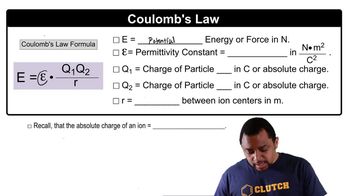
How many electrons are necessary to produce a charge of -11.0 C? What is the mass of this many electrons?
 Verified step by step guidance
 01:15
01:15
 01:53
01:53 04:12
04:12How many electrons are necessary to produce a charge of -11.0 C? What is the mass of this many electrons?
Which statements about subatomic particles are true? a. If an atom has an equal number of protons and electrons, it will be charge-neutral. b. Electrons are attracted to protons. c. Electrons are much lighter than neutrons. d. Protons have twice the mass of neutrons.
On a dry day, your body can accumulate static charge from walking across a carpet or from brushing your hair. If your body develops a charge of -22 µC (microcoulombs), how many excess electrons has it acquired?
Which statements about subatomic particles are false? a. Protons and electrons have charges of the same magnitude but opposite sign. b. Protons have about the same mass as neutrons. c. Some atoms don't have any protons. d. Protons and neutrons have charges of the same magnitude but opposite signs.
Imagine a unit of charge called the zorg. A chemist performs the oil drop experiment and measures the charge of each drop in zorgs. Based on the results shown here, what is the charge of the electron in zorgs (z)? How many electrons are in each drop?
Drop # Charge
A –4.8×10⁻⁹ z
B –9.6×10⁻⁹ z
C –6.4×10⁻⁹ z
D –12.8×10⁻⁹ z
A chemist in an imaginary universe, where electrons have a different charge than they do in our universe, performs the Millikan oil drop experiment to measure the electron's charge. The charges of several drops are recorded here. What is the charge of the electron in this imaginary universe?
Drop # Charge
A –6.9×10⁻¹⁹ C
B –9.2×10⁻¹⁹ C
C –11.5×10⁻¹⁹ C
D –4.6×10⁻¹⁹ C