
Textbook Question
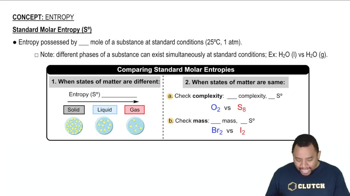
How does the molar entropy of a substance change with increasing temperature?

 Verified step by step guidance
 03:33
03:33
 00:43
00:43 03:22
03:22How does the molar entropy of a substance change with increasing temperature?
Predict the conditions (high temperature, low temperature, all temperatures, or no temperatures) under which each reaction is spontaneous. a. H2O(g) → H2O(l) b. CO2(s) → CO2(g) c. H2(g) → 2 H(g) d. 2 NO2(g) → 2 NO(g) + O2(g) (endothermic)
Rank each set of substances in order of increasing standard molar entropy (S°). Explain your reasoning. a. I2(g); F2(g); Br2(g); Cl2(g) b. H2O(g); H2O2(g); H2S(g) c. C(s, graphite); C(s, diamond); C(s, amorphous)
Rank each set of substances in order of increasing standard molar entropy (S°). Explain your reasoning. a. NH3(g); Ne(g); SO2(g); CH3CH2OH(g); He(g) c. CH4(g); CF4(g); CCl4(g)
Rank each set of substances in order of increasing standard molar entropy (S°). Explain your reasoning. b. H2O(s); H2O(l); H2O(g)
Fill in the blanks in the table. Both ΔH and ΔS refer to the system.