
Methyl red has a pKa of 5.0 and is red in its acid form and yellow in its basic form. If several drops of this indicator are placed in a 25.0-mL sample of 0.100 M HCl, what color will the solution appear? If 0.100 M NaOH is slowly added to the HCl sample, in what pH range will the indicator change color?
Ch.18 - Aqueous Ionic Equilibrium

Chapter 18, Problem 84
Is a 0.446-g sample of an unknown monoprotic acid titrated with 0.105 M KOH resulting in a titration curve sufficient to determine the molar mass and pKa of the acid?
Verified step by step guidance1
Identify the type of titration: This is a titration of a monoprotic acid with a strong base (KOH).
Determine the equivalence point: The equivalence point is reached when the moles of KOH added equal the moles of the unknown acid present in the sample.
Calculate the moles of KOH used: Use the volume of KOH solution at the equivalence point and its molarity to find the moles of KOH.
Relate moles of KOH to moles of acid: Since the acid is monoprotic, the moles of KOH will equal the moles of the acid at the equivalence point.
Calculate the molar mass of the acid: Divide the mass of the acid sample by the moles of acid to find the molar mass.
Key Concepts
Here are the essential concepts you must grasp in order to answer the question correctly.
Monoprotic Acid
A monoprotic acid is an acid that can donate only one proton (H⁺) per molecule during a chemical reaction. This characteristic simplifies the titration process, as the equivalence point can be clearly identified when the acid has completely reacted with a base, such as KOH. Understanding the behavior of monoprotic acids is essential for determining their molar mass and pKa during titration.
Recommended video:
Guided course
Binary Acids
Titration Curve
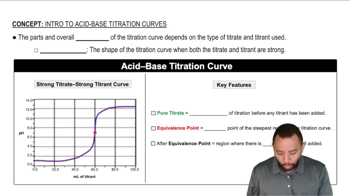
A titration curve is a graphical representation of the pH of a solution as a function of the volume of titrant added. For a monoprotic acid titrated with a strong base like KOH, the curve typically shows a sharp increase in pH at the equivalence point, where the amount of acid equals the amount of base. Analyzing the shape and features of the titration curve allows for the determination of the acid's pKa and molar mass.
Recommended video:
Guided course
Acid-Base Titration Curves
Molar Mass and pKa Determination
The molar mass of an acid can be calculated by measuring the amount of acid in grams and the number of moles of base required to reach the equivalence point during titration. The pKa, which indicates the strength of the acid, can be determined from the pH at the half-equivalence point, where half of the acid has been neutralized. Both values are critical for characterizing the unknown acid in the titration experiment.
Recommended video:
Guided course
Molar Mass Concept
Related Practice
Textbook Question
Textbook Question
A 0.229-g sample of an unknown monoprotic acid is titrated with 0.112 M NaOH. The resulting titration curve is shown here. Determine the molar mass and pKa of the acid.
1
views
Textbook Question
Consider the titration curves (labeled a and b) for two weak bases, both titrated with 0.100 M HCl. (a)
(b)
(ii) Which base has the larger Kb?
Textbook Question
Consider the titration curves (labeled a and b) for two weak acids, both titrated with 0.100 M NaOH.
(ii) Which acid has the larger Ka?
Textbook Question
A 20.0-mL sample of 0.115 M sulfurous acid (H2SO3) solution is titrated with 0.1014 M KOH. At what added volume of base solution does each equivalence point occur?
