A 25.0-mL sample of 0.125 M pyridine is titrated with 0.100 M HCl. Calculate the pH at each volume of added acid: 0 mL, 10 mL, 20 mL, equivalence point, one-half equivalence point, 40 mL, 50 mL. Sketch the titration curve.
Ch.18 - Aqueous Ionic Equilibrium

Chapter 18, Problem 81a
Consider the titration curves (labeled a and b) for two weak acids, both titrated with 0.100 M NaOH.
(i) Which acid solution is more concentrated?
Verified step by step guidance1
Step 1: Understand that a titration curve shows the pH of a solution as a function of the amount of titrant (in this case, NaOH) added. The shape of the curve can provide information about the acid being titrated.
Step 2: The initial pH of the solution before any NaOH is added is determined by the concentration and strength of the acid. A higher initial pH indicates a weaker acid or a less concentrated solution.
Step 3: The point at which the pH starts to rise significantly is called the equivalence point. This is when all the acid has reacted with the NaOH. The volume of NaOH needed to reach the equivalence point is directly related to the concentration of the acid.
Step 4: Compare the two titration curves. The curve that reaches the equivalence point with a smaller volume of NaOH corresponds to a less concentrated acid solution.
Step 5: Therefore, the acid solution that requires a larger volume of NaOH to reach the equivalence point is more concentrated.

Verified video answer for a similar problem:
This video solution was recommended by our tutors as helpful for the problem above.
Video duration:
1mWas this helpful?
Key Concepts
Here are the essential concepts you must grasp in order to answer the question correctly.
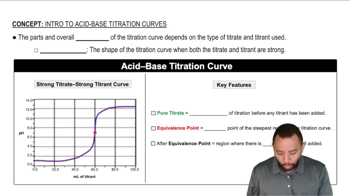
Titration Curves
Titration curves graphically represent the pH of a solution as a function of the volume of titrant added. For weak acids, the curve typically shows a gradual increase in pH, followed by a steep rise at the equivalence point. The shape and position of the curve can provide insights into the concentration and strength of the acids being titrated.
Recommended video:
Guided course
Acid-Base Titration Curves
Weak Acids and Their Concentration
Weak acids partially dissociate in solution, meaning that not all acid molecules release protons (H+). The concentration of a weak acid affects the initial pH and the steepness of the titration curve. A more concentrated weak acid will generally have a lower initial pH and a more pronounced change in pH near the equivalence point compared to a less concentrated solution.
Recommended video:
Guided course
Calculating Percent Ionization of Weak Acids
Equivalence Point
The equivalence point in a titration is reached when the amount of titrant added is stoichiometrically equivalent to the amount of substance in the solution being titrated. For weak acids titrated with a strong base like NaOH, the equivalence point is characterized by a rapid increase in pH. Analyzing the position of this point on the titration curve can help determine the concentration of the acid.
Recommended video:
Guided course
At the Equivalence Point
Related Practice
Textbook Question
Textbook Question
A 0.229-g sample of an unknown monoprotic acid is titrated with 0.112 M NaOH. The resulting titration curve is shown here. Determine the molar mass and pKa of the acid.
1
views
Textbook Question
A 25.0-mL sample of 0.125 M pyridine is titrated with 0.100 M HCl. Calculate the pH at each volume of added acid: 40 mL.
Textbook Question
A 25.0-mL sample of 0.125 M pyridine is titrated with 0.100 M HCl. Calculate the pH at each volume of added acid: 50 mL.
Textbook Question
Consider the titration curves (labeled a and b) for two weak bases, both titrated with 0.100 M HCl. (a)
(b)
(ii) Which base has the larger Kb?
Textbook Question
Consider the titration curves (labeled a and b) for two weak acids, both titrated with 0.100 M NaOH.
(ii) Which acid has the larger Ka?