
Consider the reaction and the associated equilibrium constant: aA(g) ⇌ bB(g) Kc = 4.0 Find the equilibrium concentrations of A and B for each value of a and b. Assume that the initial concentration of A in each case is 1.0 M and that no B is present at the beginning of the reaction. c. a=1;b=2
Ch.16 - Chemical Equilibrium

Chapter 16, Problem 51
Silver sulfate dissolves in water according to the reaction: Ag2SO4(s) ⇌ 2Ag+(aq) + SO42-(aq) Kc = 1.1 * 10-5 at 298K A 1.5-L solution contains 5.14 g of dissolved silver sulfate. If additional solid silver sulfate is added to the solution, will it dissolve?
Verified step by step guidance1
Calculate the molar mass of silver sulfate (Ag2SO4) using the atomic masses of Ag, S, and O.
Determine the number of moles of silver sulfate in the solution by dividing the mass of silver sulfate (5.14 g) by its molar mass.
Calculate the initial concentration of silver sulfate in the solution by dividing the number of moles by the volume of the solution (1.5 L).
Use the stoichiometry of the dissolution reaction to find the concentrations of Ag+ and SO4^2- ions at equilibrium, assuming complete dissociation of the initial amount of Ag2SO4.
Compare the calculated ion product (Q) with the given equilibrium constant (Kc) to determine if the solution is saturated, unsaturated, or supersaturated, and predict whether additional solid will dissolve.

Verified video answer for a similar problem:
This video solution was recommended by our tutors as helpful for the problem above.
Video duration:
4mWas this helpful?
Key Concepts
Here are the essential concepts you must grasp in order to answer the question correctly.
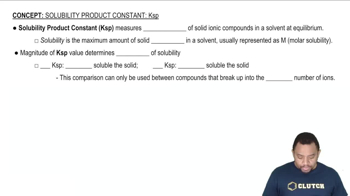
Solubility Product Constant (Ksp)
The solubility product constant (Ksp) is an equilibrium constant that applies to the solubility of sparingly soluble ionic compounds. It quantifies the extent to which a compound can dissolve in water, represented by the concentrations of its ions at equilibrium. For silver sulfate, Ksp = 1.1 x 10^-5 indicates that at equilibrium, the product of the concentrations of Ag+ and SO4^2- ions in solution will equal this value.
Recommended video:
Guided course
Solubility Product Constant
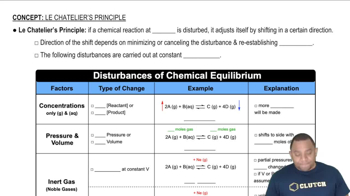
Le Chatelier's Principle
Le Chatelier's Principle states that if a system at equilibrium is disturbed, the system will adjust to counteract the disturbance and restore a new equilibrium. In the context of the silver sulfate dissolution, adding more solid Ag2SO4 increases the concentration of Ag+ and SO4^2- ions in the solution, which may shift the equilibrium position according to this principle, potentially affecting the solubility of the compound.
Recommended video:
Guided course
Le Chatelier's Principle
Saturation and Supersaturation
A solution is considered saturated when it contains the maximum concentration of solute that can dissolve at a given temperature. If additional solute is added to a saturated solution, it will not dissolve unless the solution becomes supersaturated, which occurs under specific conditions. In this case, understanding whether the current concentration of ions exceeds the Ksp value is crucial to determine if the added silver sulfate will dissolve.
Recommended video:
Guided course
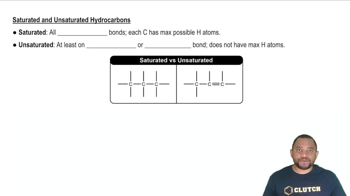
Saturated and Unsaturated Hydrocarbons
Related Practice
Textbook Question
2
views
Textbook Question
For the reaction shown here, Kc = 0.513 at 500 K. N2O4(g) ⇌ 2 NO2(g) If a reaction vessel initially contains an N2O4 concentration of 0.0500 M at 500 K, what are the equilibrium concentrations of N2O4 and NO2 at 500 K?
1
views
Textbook Question
Consider the reaction:
NH4HS(s)ΔNH3( g) + H2S( g)
At a certain temperature, Kc = 8.5 * 10 - 3. A reaction mixture at this temperature containing solid NH4HS has [NH3] = 0.0822 M and [H2S] = 0.0822M. Will more of the solid form, or will some of the existing solid decompose as equilibrium is reached?
