Consider the reaction: SO2Cl2(g) ⇌ SO2(g) + Cl2(g) Kp = 2.91*10^3 at 298 K In a reaction at equilibrium, the partial pressure of SO2 is 117 torr and that of Cl2 is 205 torr. What is the partial pressure of SO2Cl2 in this mixture?

Ch.16 - Chemical Equilibrium

Chapter 16, Problem 46
Consider the reaction: SO2Cl2(g) ⇌ SO2(g) + Cl2(g). A reaction mixture is made containing an initial [SO2Cl2] of 0.020 M. At equilibrium, [Cl2] = 1.2*10^-2 M. Calculate the value of the equilibrium constant (Kc).
Verified step by step guidance1
Identify the balanced chemical equation: \( \text{SO}_2\text{Cl}_2(g) \rightleftharpoons \text{SO}_2(g) + \text{Cl}_2(g) \).
Write the expression for the equilibrium constant \( K_c \): \( K_c = \frac{[\text{SO}_2][\text{Cl}_2]}{[\text{SO}_2\text{Cl}_2]} \).
Set up an ICE (Initial, Change, Equilibrium) table to determine the equilibrium concentrations of all species.
Use the given initial concentration of \( \text{SO}_2\text{Cl}_2 \) and the equilibrium concentration of \( \text{Cl}_2 \) to find the change in concentration and calculate the equilibrium concentrations of \( \text{SO}_2 \) and \( \text{SO}_2\text{Cl}_2 \).
Substitute the equilibrium concentrations into the \( K_c \) expression to solve for the equilibrium constant.
Key Concepts
Here are the essential concepts you must grasp in order to answer the question correctly.
Equilibrium Constant (Kc)
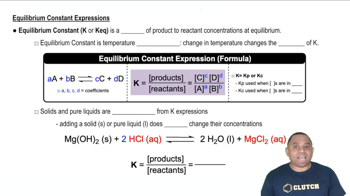
The equilibrium constant (Kc) is a numerical value that expresses the ratio of the concentrations of products to reactants at equilibrium for a given reaction at a specific temperature. It is calculated using the formula Kc = [products]^[coefficients] / [reactants]^[coefficients]. A Kc value greater than 1 indicates that products are favored at equilibrium, while a value less than 1 suggests that reactants are favored.
Recommended video:
Guided course
Equilibrium Constant Expressions
Le Chatelier's Principle
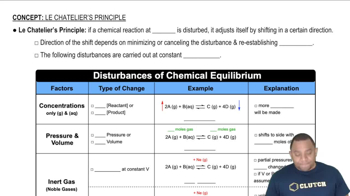
Le Chatelier's Principle states that if a dynamic equilibrium is disturbed by changing the conditions, the system will adjust itself to counteract the change and restore a new equilibrium. This principle helps predict how changes in concentration, pressure, or temperature will affect the position of equilibrium in a chemical reaction.
Recommended video:
Guided course
Le Chatelier's Principle
Stoichiometry of Reactions
Stoichiometry involves the calculation of reactants and products in chemical reactions based on the balanced chemical equation. It allows us to determine the relationships between the amounts of substances consumed and produced. In the context of equilibrium, stoichiometry is essential for calculating the concentrations of all species involved, which is necessary for determining the equilibrium constant.
Recommended video:
Guided course
Stoichiometry Concept
Related Practice
Textbook Question
Textbook Question
Consider the reaction:
NH4HS(s)ΔNH3( g) + H2S( g)
At a certain temperature, Kc = 8.5 * 10 - 3. A reaction mixture at this temperature containing solid NH4HS has [NH3] = 0.0822 M and [H2S] = 0.0822M. Will more of the solid form, or will some of the existing solid decompose as equilibrium is reached?
Textbook Question
Consider the reaction:
2 NO( g) + Br2( g)Δ2 NOBr( g) Kp = 28.4 at 298 K
In a reaction mixture at equilibrium, the partial pressure of NO is 125 torr and that of Br2 is 148 torr. What is the partial pressure of NOBr in this mixture?