Saran, the polymer used to make saran wrap, is an addition polymer formed from two monomers—vinylidene chloride and vinyl chloride. Draw the structure of the polymer. (Hint: The monomers alternate.)

Ch.13 - Solids & Modern Materials

Chapter 13, Problem 78
Polyacrylonitrile (PAN) is an addition polymer with the struc- ture shown here. Draw the structure of the monomer.
Verified step by step guidance1
Identify the repeating unit in the polymer structure of polyacrylonitrile (PAN).
Recognize that the repeating unit in an addition polymer is derived from the monomer by breaking the double bond.
Note that polyacrylonitrile is derived from acrylonitrile, which has the structure CH2=CH-CN.
Draw the structure of the monomer acrylonitrile, which includes a carbon-carbon double bond and a nitrile group (CN) attached to the second carbon.
Ensure the monomer structure is CH2=CH-CN, showing the double bond and the nitrile group clearly.

Verified video answer for a similar problem:
This video solution was recommended by our tutors as helpful for the problem above.
Video duration:
59sWas this helpful?
Key Concepts
Here are the essential concepts you must grasp in order to answer the question correctly.
Addition Polymerization
Addition polymerization is a process where monomers with unsaturated bonds (like double bonds) react to form a polymer. In this reaction, the double bonds of the monomers open up, allowing them to link together into long chains. This type of polymerization is common in the formation of plastics and synthetic fibers, such as polyacrylonitrile.
Recommended video:
Guided course
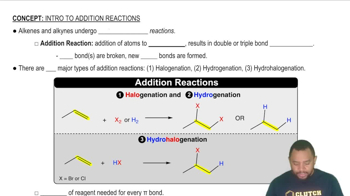
Addition Reactions
Monomer Structure
A monomer is a small, simple molecule that can join together to form a polymer. The structure of a monomer typically contains functional groups that facilitate the polymerization process. For polyacrylonitrile, the monomer is acrylonitrile, which consists of a vinyl group and a nitrile group, allowing it to undergo addition polymerization.
Recommended video:
Guided course
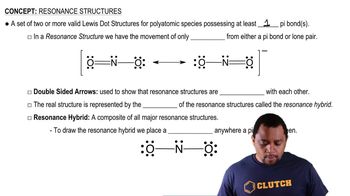
Resonance Structures
Chemical Structure Representation
Chemical structure representation involves depicting the arrangement of atoms within a molecule. This can be done using various formats, such as Lewis structures, condensed formulas, or skeletal structures. Understanding how to draw and interpret these representations is crucial for visualizing the monomer's structure and its transformation into a polymer.
Recommended video:
Guided course
Chemical Properties
Related Practice
Textbook Question
Textbook Question
The density of an unknown metal is 12.3 g/cm3, and its atomic radius is 0.134 nm. It has a face-centered cubic lattice. Find the atomic mass of this metal
Textbook Question
Copper iodide crystallizes in the zinc blende structure. The sep- aration between nearest neighbor cations and anions is approximately 311 pm, and the melting point is 606 °C. Potassium chloride, by contrast, crystallizes in the rock salt structure. Even though the separation between nearest-neighbor cations and anions is greater (319 pm), the melting point of potassium chlo- ride is higher (776 °C). Explain.
Textbook Question
Teflon is an addition polymer formed from the monomer shown here. Draw the structure of the polymer.