Which solid in each pair has the higher melting point and why? d. NaCl(s) or CaO(s)

Ch.13 - Solids & Modern Materials

Chapter 13, Problem 50
An oxide of rhenium crystallizes with the unit cell shown here (rhenium=gray; oxygen=red). What is the formula of the oxide?
Verified step by step guidance1
Identify the type of unit cell and the positions of the atoms within the unit cell.
Count the number of rhenium atoms in the unit cell. Consider atoms at corners, edges, faces, and within the cell.
Count the number of oxygen atoms in the unit cell. Consider atoms at corners, edges, faces, and within the cell.
Determine the ratio of rhenium to oxygen atoms in the unit cell.
Use the ratio to write the empirical formula of the oxide.

Verified video answer for a similar problem:
This video solution was recommended by our tutors as helpful for the problem above.
Video duration:
1mWas this helpful?
Key Concepts
Here are the essential concepts you must grasp in order to answer the question correctly.
Unit Cell Structure
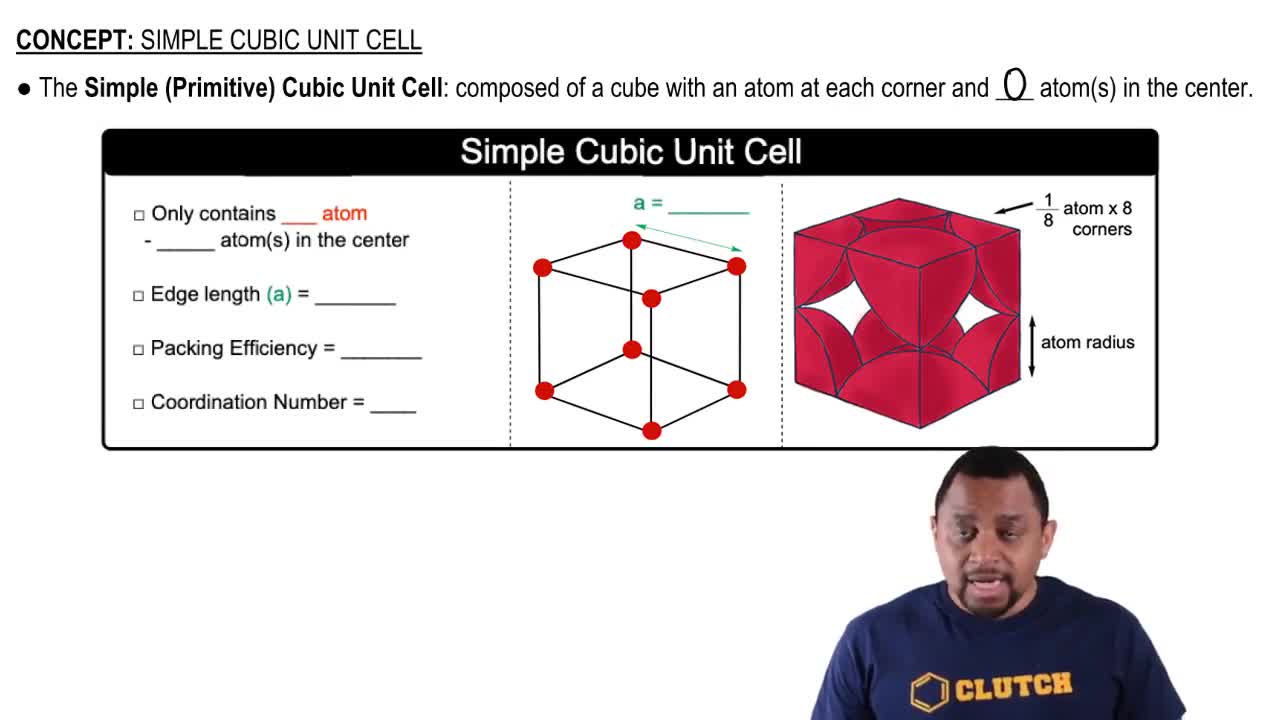
A unit cell is the smallest repeating unit in a crystal lattice that reflects the symmetry and structure of the entire crystal. Understanding the arrangement of atoms within the unit cell is crucial for determining the overall composition and formula of the compound. In this case, the positions of rhenium and oxygen atoms within the unit cell will help deduce the stoichiometry of the oxide.
Recommended video:
Guided course
Simple Cubic Unit Cell
Stoichiometry
Stoichiometry involves the calculation of reactants and products in chemical reactions, based on the conservation of mass. In the context of determining the formula of a compound, it refers to the ratio of different elements present in the compound. By analyzing the number of rhenium and oxygen atoms in the unit cell, one can derive the empirical formula of the oxide.
Recommended video:
Guided course
Stoichiometry Concept
Oxide Compounds
Oxides are compounds formed by the reaction of oxygen with another element, typically resulting in a binary compound. The properties and formulas of oxides can vary significantly based on the oxidation states of the metal involved. In this case, understanding the common oxidation states of rhenium will aid in predicting the possible formula of the rhenium oxide based on its crystal structure.
Recommended video:
Guided course
Oxide Reactions
Related Practice
Textbook Question
Textbook Question
Classify each of the following as a component of a silicate ceramic, an oxide ceramic, or a nonoxide ceramic. a. B4C
Textbook Question
Which solid in each pair has the higher melting point and why?
a. TiO2(s) or HOOH(s)
b. CCl4(s) or SiCl4(s)
c. Kr(s) or Xe(s)
Textbook Question
Identify the structure of each of the two unit cells shown in Problem 52 as the rock salt structure, zinc blende structure, fluorite structure, antifluorite structure, or none of these.
Textbook Question
Which solid in each pair has the higher melting point and why?
a. Fe(s) or CCl4(s)
b. KCl(s) or HCl(s)
c. Ti(s) or Ne(s)
d. H2O(s) or H2S(s)
Textbook Question
Classify each of the following as a component of a silicate ceramic, an oxide ceramic, or a nonoxide ceramic. b. Mg2SiO4