Write a hybridization and bonding scheme for each molecule. Sketch the molecule, including overlapping orbitals, and label all bonds using the notation shown in Examples 11.6 and 11.7. a. CCl4

Ch.11 - Chemical Bonding II: Molecular Shapes, VSEPR & MO Theory

All textbooks
Tro 6th Edition
Ch.11 - Chemical Bonding II: Molecular Shapes, VSEPR & MO Theory
Problem 60
Tro 6th Edition
Ch.11 - Chemical Bonding II: Molecular Shapes, VSEPR & MO Theory
Problem 60Chapter 11, Problem 60
Which hybridization scheme allows the central atom to form more than four bonds? sp3, sp3d, sp2
Verified step by step guidance1
Identify the hybridization schemes given: \(sp^3\), \(sp^3d\), and \(sp^2\).
Understand that \(sp^3\) hybridization involves one s orbital and three p orbitals, allowing for a maximum of four bonds.
Recognize that \(sp^2\) hybridization involves one s orbital and two p orbitals, allowing for a maximum of three bonds.
Consider \(sp^3d\) hybridization, which involves one s orbital, three p orbitals, and one d orbital, allowing for more than four bonds.
Conclude that \(sp^3d\) hybridization allows the central atom to form more than four bonds, typically up to five bonds.

Verified video answer for a similar problem:
This video solution was recommended by our tutors as helpful for the problem above.
Video duration:
4mWas this helpful?
Key Concepts
Here are the essential concepts you must grasp in order to answer the question correctly.
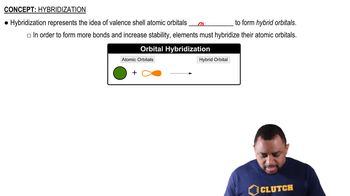
Hybridization
Hybridization is a concept in chemistry that describes the mixing of atomic orbitals to form new hybrid orbitals. These hybrid orbitals can accommodate the bonding requirements of a central atom, allowing it to form covalent bonds with surrounding atoms. The type of hybridization (e.g., sp, sp2, sp3) determines the geometry and number of bonds that can be formed.
Recommended video:
Guided course
Hybridization
Types of Hybridization
Different types of hybridization correspond to different bonding scenarios. For example, sp3 hybridization involves one s and three p orbitals, allowing for four equivalent bonds, typically seen in tetrahedral geometries. In contrast, sp3d hybridization includes one s, three p, and one d orbital, enabling the formation of five bonds, as seen in trigonal bipyramidal geometries.
Recommended video:
Guided course
Hybridization
Coordination Number
The coordination number refers to the number of bonds formed by a central atom in a molecule. It is crucial for understanding the hybridization scheme, as a higher coordination number indicates the ability to form more bonds. For instance, a central atom with sp3d hybridization can achieve a coordination number of five, allowing it to bond with five other atoms.
Recommended video:
Guided course
Coordination Numbers
Related Practice
Textbook Question
Textbook Question
Write orbital diagrams (boxes with arrows in them) to represent the electron configurations of carbon before and after sp hybridization.
Textbook Question
Write a hybridization and bonding scheme for each molecule. Sketch the molecule, including overlapping orbitals, and label all bonds using the notation shown in Examples 11.6 and 11.7. c. OF2
Textbook Question
Write a hybridization and bonding scheme for each molecule. Sketch the molecule, including overlapping orbitals, and label all bonds using the notation shown in Examples 11.6 and 11.7. b. NH3
Textbook Question
Which hybridization scheme allows the formation of at least one p bond? sp3, sp2, sp3d2
Textbook Question
Write orbital diagrams (boxes with arrows in them) to represent the electron configuration of carbon before and after sp3 hybridization.