The value of the euro was recently \$1.15 U.S., and the price of 1 liter of gasoline in France is 1.42 euro. What is the price of 1 gallon of gasoline in U.S. dollars in France?

Ch.1 - Matter, Measurement & Problem Solving

Chapter 1, Problem 117
Force is defined as mass times acceleration. Starting with SI base units, derive a unit for force. Using SI prefixes, suggest a convenient unit for the force resulting from a collision with a 10-ton trailer truck moving at 55 mi per hour and for the force resulting from the collision of a molecule of mass around 10 - 20 kg moving almost at the speed of light (3×10⁸ m/s) with the wall of its container. (Assume a 1-second deceleration time for both collisions.)
Verified step by step guidance1
Start by recalling the formula for force: \( F = m \cdot a \), where \( m \) is mass and \( a \) is acceleration.
Express mass \( m \) in terms of its SI base unit, which is kilograms (kg).
Express acceleration \( a \) in terms of its SI base units: \( a = \frac{\text{change in velocity}}{\text{time}} = \frac{\text{m/s}}{\text{s}} = \text{m/s}^2 \).
Combine these to derive the SI unit for force: \( \text{kg} \cdot \text{m/s}^2 \), which is defined as a newton (N).
For the truck collision, convert the truck's mass to kilograms and speed to meters per second, then calculate the force using \( F = m \cdot a \) with \( a = \frac{\text{velocity}}{\text{time}} \). For the molecule, use its mass and speed similarly, considering the deceleration time.

Verified video answer for a similar problem:
This video solution was recommended by our tutors as helpful for the problem above.
Video duration:
4mWas this helpful?
Key Concepts
Here are the essential concepts you must grasp in order to answer the question correctly.
Newton's Second Law of Motion
Newton's Second Law states that the force acting on an object is equal to the mass of that object multiplied by its acceleration (F = ma). This fundamental principle allows us to calculate the force exerted during a collision by determining the change in velocity over a specified time period, which is essential for understanding the dynamics of both macroscopic and microscopic collisions.
Recommended video:
Guided course
Second Law of Thermodynamics Example
SI Units and Prefixes
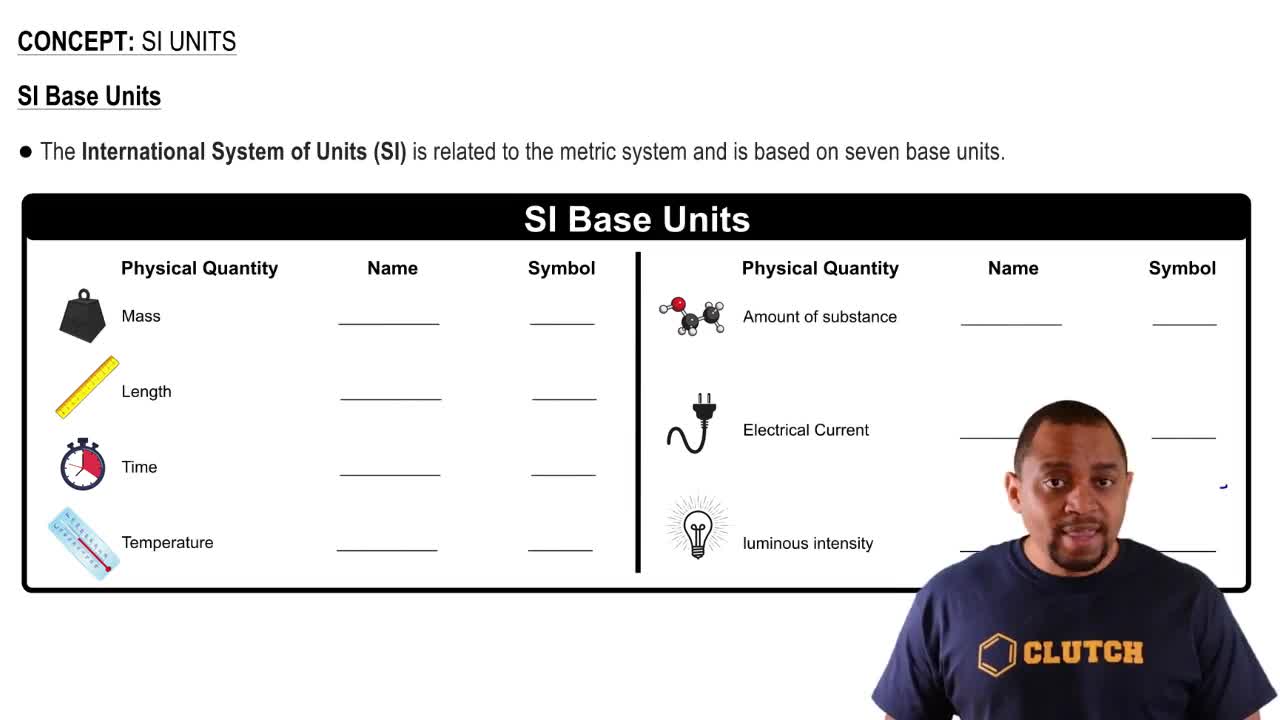
The International System of Units (SI) provides a standardized set of units for measurement, including the unit of force, the Newton (N), which is defined as 1 kg·m/s². SI prefixes, such as kilo- (10³) and mega- (10⁶), help express large or small quantities conveniently, making it easier to communicate measurements in scientific contexts, such as the forces involved in collisions.
Recommended video:
Guided course
SI Units
Momentum and Impulse
Momentum is the product of an object's mass and its velocity, and it is conserved in isolated systems. Impulse, defined as the change in momentum, is equal to the force applied multiplied by the time duration of that force. Understanding these concepts is crucial for analyzing collisions, as they help quantify the effects of forces during rapid interactions, such as those described in the question.
Recommended video:
Guided course
Angular Momentum Quantum Number
Related Practice
Textbook Question
Textbook Question
A thief uses a can of sand to replace a solid gold cylinder that sits on a weight-sensitive, alarmed pedestal. The can of sand and the gold cylinder have exactly the same dimensions (length = 22 and radius = 3.8 cm). a. Calculate the mass of each cylinder (ignore the mass of the can itself). (density of gold = 19.3 g/cm3, density of sand = 3.00 g/cm3) b. Does the thief set off the alarm? Explain.
1
views
Textbook Question
On a new Jekyll temperature scale, water freezes at 17 °J and boils at 97 °J. On another new temperature scale, the Hyde scale, water freezes at 0 °H and boils at 120 °H. If methyl alcohol boils at 84 °H, what is its boiling point on the Jekyll scale?
8
views
Textbook Question
At what temperatures are the readings on the Fahrenheit and Celsius thermometers the same?
6
views