
Ch.7 - Thermochemistry
Tro - Chemistry: A Molecular Approach 5th Edition
Tro5th EditionChemistry: A Molecular ApproachISBN: 9780134874371Not the one you use?Change textbook
Chapter 7, Problem 80

Calculate ΔHrxn for the reaction:
CaO(s) + CO2(g) → CaCO3(s)
Use the following reactions and given ΔH's:
Ca(s) + CO2(g) + 1/2 O2(g) → CaCO3(s) ΔH = –812.8 kJ
2 Ca(s) + O2(g) → 2 CaO(s) ΔH = –1269.8 kJ

Verified step by step guidance
1
Identify the target reaction and the given reactions. The target reaction is: CaO(s) + CO2(g) → CaCO3(s).
Write down the given reactions and their enthalpies: Reaction 1: Ca(s) + CO2(g) + \(\frac{1}{2}\) O2(g) → CaCO3(s), ΔH = -812.8 kJ. Reaction 2: 2 Ca(s) + O2(g) → 2 CaO(s), ΔH = -1269.8 kJ.
Adjust the stoichiometry of the given reactions to match the components of the target reaction. For Reaction 2, divide the entire reaction by 2 to match the stoichiometry of CaO in the target reaction: Ca(s) + \(\frac{1}{2}\) O2(g) → CaO(s), ΔH = -1269.8 kJ / 2.
Add or subtract the adjusted reactions to obtain the target reaction. Add the adjusted Reaction 2 to Reaction 1: Ca(s) + \(\frac{1}{2}\) O2(g) → CaO(s) + Ca(s) + CO2(g) + \(\frac{1}{2}\) O2(g) → CaCO3(s). Simplify to get the target reaction: CaO(s) + CO2(g) → CaCO3(s).
Calculate ΔH for the target reaction by adding the ΔH values of the adjusted reactions: ΔH(target) = ΔH(adjusted Reaction 2) + ΔH(Reaction 1).

Verified video answer for a similar problem:

This video solution was recommended by our tutors as helpful for the problem above.
Video duration:
2m

Key Concepts

Here are the essential concepts you must grasp in order to answer the question correctly.

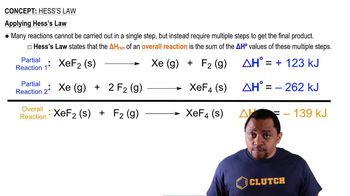
Hess's Law

Hess's Law states that the total enthalpy change for a reaction is the sum of the enthalpy changes for the individual steps of the reaction, regardless of the pathway taken. This principle allows us to calculate the enthalpy change of a reaction by using known enthalpy changes of related reactions, making it essential for solving problems involving ΔHrxn.
Recommended video:

Standard Enthalpy of Formation

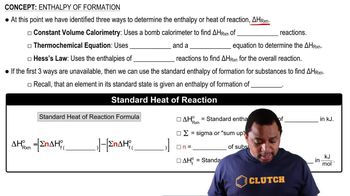
The standard enthalpy of formation (ΔHf°) is the change in enthalpy when one mole of a compound is formed from its elements in their standard states. This concept is crucial for calculating reaction enthalpies, as it provides a reference point for the energy changes associated with forming compounds from their constituent elements.
Recommended video:
Guided course
02:34
Enthalpy of Formation

Enthalpy Change (ΔH)

Enthalpy change (ΔH) is a measure of the heat absorbed or released during a chemical reaction at constant pressure. It is a key concept in thermodynamics, allowing chemists to understand energy changes in reactions, predict reaction spontaneity, and calculate the energy required or released in various chemical processes.
Recommended video:
Guided course
02:34
Enthalpy of Formation