Ch.20 - Electrochemistry
Tro - Chemistry: A Molecular Approach 5th Edition
Tro5th EditionChemistry: A Molecular ApproachISBN: 9780134874371Not the one you use?Change textbook
Chapter 20, Problem 66

Use tabulated electrode potentials to calculate ∆G°rxn for each reaction at 25 °C. a. 2 Fe3+(aq) + 3 Sn(s) → 2 Fe(s) + 3 Sn2+(aq) b. O2(g) + 2 H2O(l) + 2 Cu(s) → 4 OH(aq) + 2 Cu2+(aq) c. Br2(l) + 2 I(aq) → 2 Br(aq) + I2(s)

Verified step by step guidance
1
Identify the half-reactions involved in the redox process. For the given reaction, the half-reactions are: \( \text{Br}_2(l) + 2e^- \rightarrow 2\text{Br}^-(aq) \) and \( 2\text{I}^-(aq) \rightarrow \text{I}_2(s) + 2e^- \).
Look up the standard electrode potentials (E°) for each half-reaction from a table of standard reduction potentials. Note that the potential for the oxidation half-reaction (\( 2\text{I}^-(aq) \rightarrow \text{I}_2(s) + 2e^- \)) will be the negative of the reduction potential.
Calculate the standard cell potential (E°cell) for the reaction by subtracting the anode potential (oxidation) from the cathode potential (reduction): \( E^\circ_{\text{cell}} = E^\circ_{\text{cathode}} - E^\circ_{\text{anode}} \).
Use the Nernst equation to relate the standard cell potential to the standard Gibbs free energy change: \( \Delta G^\circ_{\text{rxn}} = -nFE^\circ_{\text{cell}} \), where \( n \) is the number of moles of electrons transferred (2 in this case) and \( F \) is the Faraday constant (approximately 96485 C/mol).
Substitute the values for \( n \), \( F \), and \( E^\circ_{\text{cell}} \) into the equation to calculate \( \Delta G^\circ_{\text{rxn}} \).

Verified video answer for a similar problem:

This video solution was recommended by our tutors as helpful for the problem above.
Video duration:
8m

Key Concepts

Here are the essential concepts you must grasp in order to answer the question correctly.

Electrode Potentials

Electrode potentials, measured in volts, indicate the tendency of a chemical species to be reduced. Standard electrode potentials (E°) are measured under standard conditions (1 M concentration, 1 atm pressure, and 25 °C). These values are crucial for predicting the direction of redox reactions and calculating the Gibbs free energy change (∆G°rxn) for reactions.
Recommended video:
Guided course
01:27
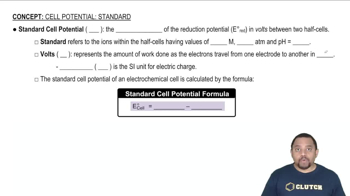
Standard Cell Potential

Gibbs Free Energy (∆G°rxn)

Gibbs free energy change (∆G°rxn) is a thermodynamic quantity that indicates the spontaneity of a reaction at standard conditions. It can be calculated using the equation ∆G°rxn = -nFE°cell, where n is the number of moles of electrons transferred, F is Faraday's constant, and E°cell is the cell potential derived from the electrode potentials of the half-reactions.
Recommended video:
Guided course
01:51
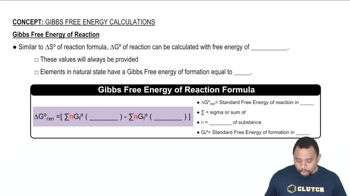
Gibbs Free Energy of Reactions

Half-Reaction Method

The half-reaction method involves breaking down a redox reaction into its oxidation and reduction half-reactions. Each half-reaction can be assigned a standard electrode potential, which allows for the calculation of the overall cell potential (E°cell). This method is essential for determining the Gibbs free energy change and understanding the electron transfer processes in the reaction.
Recommended video:
Guided course
01:49
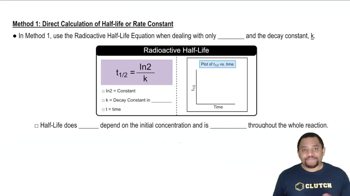
Method 1 of Radioactive Half-Life