Ch.18 - Aqueous Ionic Equilibrium
Tro - Chemistry: A Molecular Approach 5th Edition
Tro5th EditionChemistry: A Molecular ApproachISBN: 9780134874371Not the one you use?Change textbook
Chapter 18, Problem 28

A formic acid solution has a pH of 3.25. Which of these substances will raise the pH of the solution upon addition? Explain your answer. a. HCl b. NaBr c. NaCHO2 d. KCl

Verified step by step guidance
1
insert step 1: Understand that pH is a measure of the acidity or basicity of a solution. A lower pH indicates a more acidic solution, while a higher pH indicates a more basic solution.
insert step 2: Recognize that adding a strong acid like HCl will lower the pH further, making the solution more acidic.
insert step 3: Identify that NaBr and KCl are salts of strong acids and strong bases, which are neutral in solution and will not significantly change the pH.
insert step 4: Note that NaCHO2 (sodium formate) is the salt of a weak acid (formic acid) and a strong base (sodium hydroxide). It will act as a weak base in solution, raising the pH.
insert step 5: Conclude that adding NaCHO2 will raise the pH of the formic acid solution, as it will partially neutralize the acid, making the solution less acidic.

Verified video answer for a similar problem:

This video solution was recommended by our tutors as helpful for the problem above.
Video duration:
1m

Key Concepts

Here are the essential concepts you must grasp in order to answer the question correctly.

pH Scale

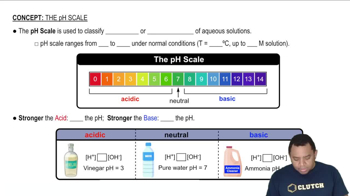
The pH scale measures the acidity or basicity of a solution, ranging from 0 to 14. A pH of 7 is neutral, below 7 indicates acidity, and above 7 indicates basicity. In this context, a solution with a pH of 3.25 is acidic, meaning it has a higher concentration of hydrogen ions (H+) compared to hydroxide ions (OH-). Understanding the pH scale is essential for determining how different substances will affect the acidity or basicity of the solution.
Recommended video:

Acid-Base Reactions

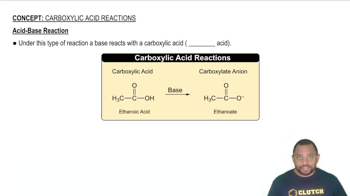
Acid-base reactions involve the transfer of protons (H+) between substances. Acids donate protons, while bases accept them. When a base is added to an acidic solution, it can neutralize some of the hydrogen ions, thereby increasing the pH. Identifying whether a substance is an acid or a base is crucial for predicting its effect on the pH of the solution.
Recommended video:
Guided course
01:09
Acid-Base Reaction

Buffer Solutions

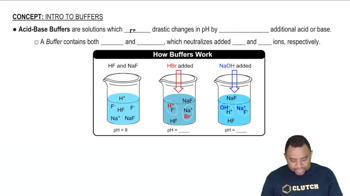
Buffer solutions resist changes in pH when small amounts of acid or base are added. They typically consist of a weak acid and its conjugate base or a weak base and its conjugate acid. In the case of formic acid, which is a weak acid, the addition of a conjugate base (like sodium formate, NaCHO2) can help raise the pH by neutralizing excess H+ ions, making it important to recognize the role of buffers in pH changes.
Recommended video:
Guided course
03:02
Buffer Solutions