Ch.17 - Acids and Bases
Tro - Chemistry: A Molecular Approach 5th Edition
Tro5th EditionChemistry: A Molecular ApproachISBN: 9780134874371Not the one you use?Change textbook
Chapter 17, Problem 100d

Determine whether each cation is acidic or pH-neutral. For each cation that is acidic, write an equation that shows how the cation acts as an acid. d. Li+

Verified step by step guidance
1
Identify the nature of the cation: Li^+ is a Group 1 metal cation.
Recall that cations from Group 1 metals, such as Li^+, are typically pH-neutral because they do not react with water to form H^+ ions.
Understand that acidic cations are usually those that can donate a proton (H^+) or increase the concentration of H^+ in solution.
Since Li^+ does not have the ability to donate a proton or increase H^+ concentration, it is considered pH-neutral.
Conclude that Li^+ is a pH-neutral cation and does not act as an acid in aqueous solution.

Verified video answer for a similar problem:

This video solution was recommended by our tutors as helpful for the problem above.
Video duration:
1m

Key Concepts

Here are the essential concepts you must grasp in order to answer the question correctly.

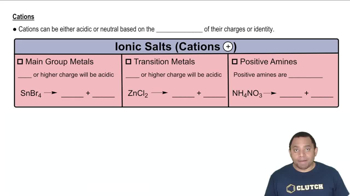
Acidic Cations

Acidic cations are positively charged ions that can donate protons (H+) in solution, thereby lowering the pH. These cations typically come from weak bases or are transition metals that can hydrolyze in water, forming acidic solutions. Understanding whether a cation is acidic involves analyzing its ability to interact with water and affect the concentration of hydrogen ions.
Recommended video:
Guided course
02:26
Cation Acidity in Salts

pH Neutral Cations

pH neutral cations do not significantly affect the pH of a solution. They are usually derived from strong bases and do not hydrolyze in water, meaning they do not release protons. An example of a pH-neutral cation is Li+, which does not react with water to produce H+ ions, thus maintaining a neutral pH.
Recommended video:

Hydrolysis Reactions

Hydrolysis reactions involve the reaction of a cation with water, leading to the formation of an acid or base. In the case of acidic cations, hydrolysis results in the release of H+ ions, which can be represented by an equation. For example, if a cation is acidic, the hydrolysis reaction can be written as: M^n+ + H2O ⇌ MH(n-1)+ + H+, where M^n+ is the cation.
Recommended video:
Guided course
01:30
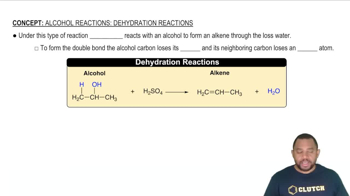
Alcohol Reactions: Dehydration Reactions