Ch.15 - Chemical Kinetics
Tro - Chemistry: A Molecular Approach 5th Edition
Tro5th EditionChemistry: A Molecular ApproachISBN: 9780134874371Not the one you use?Change textbook
Chapter 15, Problem 109

A certain substance X decomposes. Fifty percent of X remains after 100 minutes. How much X remains after 200 minutes if the reaction order with respect to X is (c) second order?

Verified step by step guidance
1
Identify the reaction order: The problem states that the reaction is second order with respect to X.
Use the second-order integrated rate law: \( \frac{1}{[X]} = kt + \frac{1}{[X]_0} \), where \([X]_0\) is the initial concentration, \([X]\) is the concentration at time \(t\), and \(k\) is the rate constant.
Determine the rate constant \(k\): Use the information that 50% of X remains after 100 minutes. This means \([X] = \frac{1}{2}[X]_0\) at \(t = 100\) minutes. Substitute these values into the second-order rate law to solve for \(k\).
Calculate \([X]\) at 200 minutes: Use the value of \(k\) obtained from the previous step and substitute \(t = 200\) minutes into the second-order rate law to find \([X]\) at this time.
Interpret the result: The calculated \([X]\) will tell you how much of the substance X remains after 200 minutes.

Verified video answer for a similar problem:

This video solution was recommended by our tutors as helpful for the problem above.
Video duration:
2m

Key Concepts

Here are the essential concepts you must grasp in order to answer the question correctly.

Reaction Order

Reaction order refers to the power to which the concentration of a reactant is raised in the rate law of a chemical reaction. It indicates how the rate of reaction depends on the concentration of reactants. For example, a second-order reaction means that the rate is proportional to the square of the concentration of the reactant, which significantly influences how the concentration changes over time.
Recommended video:
Guided course
00:36
Average Bond Order

Half-Life in Second-Order Reactions

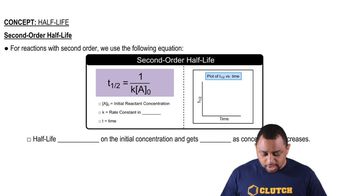
The half-life of a substance in a second-order reaction is inversely proportional to the initial concentration of the reactant. Unlike first-order reactions, where the half-life is constant, the half-life for second-order reactions increases as the reaction proceeds. This means that as time goes on, it takes longer for the concentration of the reactant to decrease by half.
Recommended video:
Guided course
01:44
Second-Order Half-Life

Integrated Rate Law for Second-Order Reactions

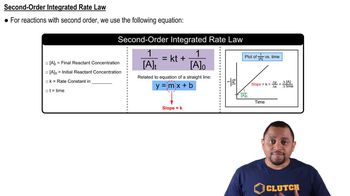
The integrated rate law for a second-order reaction can be expressed as 1/[X] = kt + 1/[X]₀, where [X] is the concentration of the reactant at time t, k is the rate constant, and [X]₀ is the initial concentration. This equation allows us to calculate the concentration of the reactant at any given time, which is essential for determining how much of substance X remains after a specified duration.
Recommended video:
Guided course
01:59
Second-Order Reactions