Based on the molecular diagram, classify each change as physical or chemical.
Ch.1 - Matter, Measurement & Problem Solving
Chapter 1, Problem 54
The warmest temperature ever measured in the United States is 134 °F, recorded on July 10, 1913, in Death Valley, California. Convert that temperature to °C and K.
Verified step by step guidance1
First, convert the temperature from Fahrenheit (°F) to Celsius (°C) using the formula: \( C = \frac{5}{9} \times (F - 32) \), where \( F \) is the temperature in Fahrenheit.
Substitute 134 °F into the formula to find the temperature in Celsius.
Next, convert the temperature from Celsius (°C) to Kelvin (K) using the formula: \( K = C + 273.15 \), where \( C \) is the temperature in Celsius.
Substitute the result from step 2 into the formula to find the temperature in Kelvin.
Ensure to check the units in your final answers to confirm they are in °C and K respectively.

Verified video answer for a similar problem:
This video solution was recommended by our tutors as helpful for the problem above.
Video duration:
2mKey Concepts
Here are the essential concepts you must grasp in order to answer the question correctly.
Temperature Scales
Temperature can be measured in different scales, primarily Celsius (°C), Fahrenheit (°F), and Kelvin (K). Each scale has its own zero point and degree increments. Understanding how these scales relate to one another is essential for converting temperatures accurately.
Recommended video:
Guided course
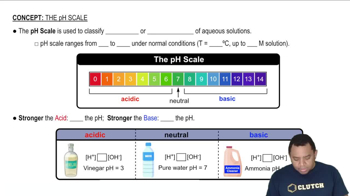
The pH Scale
Conversion Formulas
To convert temperatures between Fahrenheit and Celsius, the formula is °C = (°F - 32) × 5/9. For converting Celsius to Kelvin, the formula is K = °C + 273.15. Mastery of these formulas is crucial for performing temperature conversions correctly.
Recommended video:
Guided course
Conversion Factors
Absolute Zero
Kelvin is an absolute temperature scale where 0 K represents absolute zero, the theoretical point where molecular motion ceases. This scale is used in scientific contexts because it provides a direct measure of thermal energy. Understanding this concept helps in grasping the significance of temperature in physical sciences.
Recommended video:
Guided course
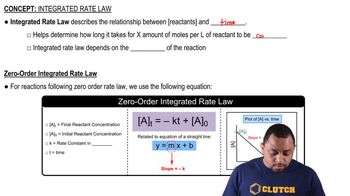
Zero-Order Reactions
Related Practice
Textbook Question
34
views
1
rank
Textbook Question
Use the prefix multipliers to express each measurement without exponents. a. 1.2×10⁻⁹ m
2
views
Textbook Question
Convert each temperature. a. 32 °F to °C (temperature at which water freezes) b. 77 K to °F (temperature of liquid nitrogen) c. -109 °F to °C (temperature of dry ice) d. 98.6 °F to K (body temperature)
7
views
Textbook Question
Use the prefix multipliers to express each measurement without exponents. d. 3.5×10⁶ L
3
views
Textbook Question
Classify each change as physical or chemical. a. Natural gas burns in a stove. b. The liquid propane in a gas grill evaporates because the valve was left open. c. The liquid propane in a gas grill burns in a flame. d. A bicycle frame rusts on repeated exposure to air and water.
24
views
1
rank
Textbook Question
Use the prefix multipliers to express each measurement without exponents. b. 22×10−15 s
4
views