
Textbook Question
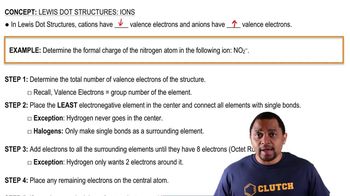
Each compound contains both ionic and covalent bonds. Write ionic Lewis structures for each, including the covalent structure for the ion in brackets. Write resonance structures if necessary. b. Ca(OH)2 c. KNO3 d. LiIO
 Verified step by step guidance
 04:28
04:28
 02:11
02:11 02:12
02:12Each compound contains both ionic and covalent bonds. Write ionic Lewis structures for each, including the covalent structure for the ion in brackets. Write resonance structures if necessary. b. Ca(OH)2 c. KNO3 d. LiIO
In the Chemistry and the Environment box on free radicals in this chapter, we discussed the importance of the hydroxyl radical in reacting with and eliminating many atmospheric pollutants. However, the hydroxyl radical does not clean up everything. For example, chlorofluorocarbons—which destroy stratospheric ozone—are not attacked by the hydroxyl radical. Consider the hypothetical reaction by which the hydroxyl radical might react with a chlorofluorocarbon: OH(g) + CF2Cl2(g) → HOF(g) + CFCl2(g) Use bond energies to explain why this reaction is improbable. (The C–F bond energy is 552 kJ/mol.)
Ethane burns in air to form carbon dixode and water vapor.
2 H3C¬CH3( g) + 7 O2( g)¡4 CO2( g) + 6 H2O( g)
Use average bond energies to calculate ΔHrxn for the reaction.
Each compound contains both ionic and covalent bonds. Write ionic Lewis structures for each, including the covalent structure for the ion in brackets. Write resonance structures if necessary. a. BaCO3