Write balanced complete ionic and net ionic equations for each reaction. d. HC2H3O2(aq) + K2CO3(aq) → H2O(l ) + CO2(g) + KC2H3O2(aq)
Ch.5 - Introduction to Solutions and Aqueous Solutions
Chapter 5, Problem 47d
Write balanced complete ionic and net ionic equations for each reaction. d. Na3PO4(aq) + NiCl2(aq) → Ni3(PO4)2(s) + NaCl(aq)
Verified step by step guidance1
Identify the reactants and products in the given chemical equation: Na_3PO_4(aq) + NiCl_2(aq) → Ni_3(PO_4)_2(s) + NaCl(aq).
Write the balanced molecular equation for the reaction: 2 Na_3PO_4(aq) + 3 NiCl_2(aq) → Ni_3(PO_4)_2(s) + 6 NaCl(aq).
Write the complete ionic equation by breaking all the soluble ionic compounds into their respective ions: 6 Na^+(aq) + 2 PO_4^{3-}(aq) + 3 Ni^{2+}(aq) + 6 Cl^-(aq) → Ni_3(PO_4)_2(s) + 6 Na^+(aq) + 6 Cl^-(aq).
Identify and cancel out the spectator ions that appear on both sides of the complete ionic equation: Na^+(aq) and Cl^-(aq).
Write the net ionic equation by including only the ions and compounds that participate in the reaction: 2 PO_4^{3-}(aq) + 3 Ni^{2+}(aq) → Ni_3(PO_4)_2(s).

Verified video answer for a similar problem:
This video solution was recommended by our tutors as helpful for the problem above.
Video duration:
4mWas this helpful?
Key Concepts
Here are the essential concepts you must grasp in order to answer the question correctly.
Ionic Compounds and Solubility
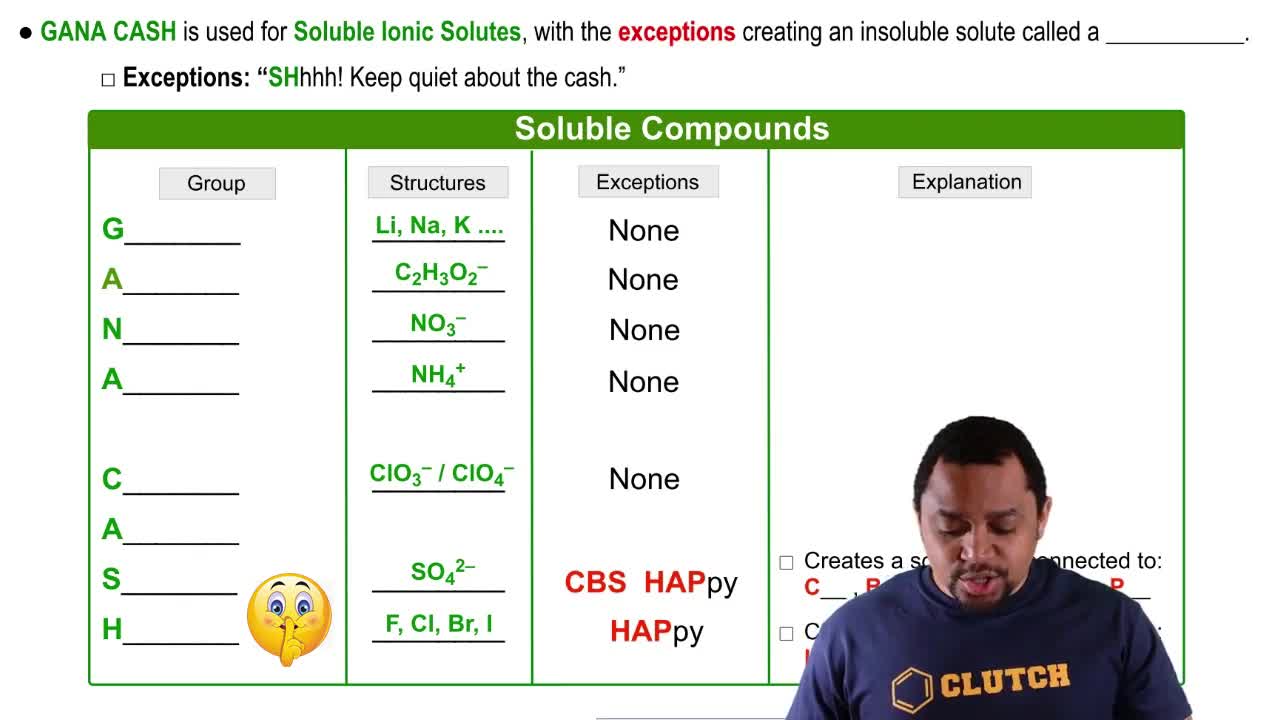
Ionic compounds consist of positively and negatively charged ions. Their solubility in water is determined by the strength of the ionic bonds and the interactions with water molecules. For example, sodium phosphate (Na3PO4) and nickel(II) chloride (NiCl2) are soluble in water, dissociating into their respective ions, which is crucial for writing complete ionic equations.
Recommended video:
Guided course
Soluble Ionic Solutes
Complete Ionic Equations
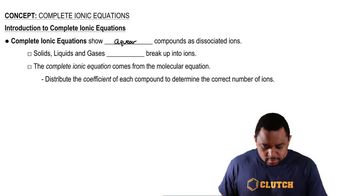
A complete ionic equation shows all the ions present in a reaction, including spectator ions that do not participate in the actual chemical change. In the given reaction, the complete ionic equation would include all ions from the reactants and products, allowing for a clear visualization of the species involved before simplification to the net ionic equation.
Recommended video:
Guided course
Complete Ionic Equations
Net Ionic Equations
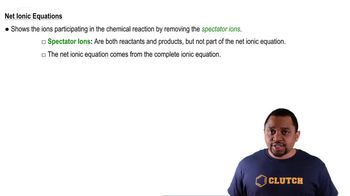
A net ionic equation represents only the species that undergo a chemical change during the reaction, omitting spectator ions. This simplification highlights the actual reaction taking place, such as the formation of solid nickel(II) phosphate (Ni3(PO4)2) from the ions in solution, providing a clearer understanding of the chemical process.
Recommended video:
Guided course
Net Ionic Equations
Related Practice
Textbook Question
Textbook Question
Write balanced complete ionic and net ionic equations for each reaction.
a. K2SO4(aq) + CaI2(aq) → CaSO4(s) + KI(aq)
b. NH4Cl(aq) + NaOH(aq) → H2O(l) + NH3(g) + NaCl(aq)
c. AgNO3(aq) + NaCl(aq) → AgCl(s) + NaNO3(aq)
Textbook Question
Write balanced complete ionic and net ionic equations for each reaction.
c. NaOH(aq) + HC2H3O2(aq) → H2O(l ) + NaC2H3O2(aq)
d. Na3PO4(aq) + NiCl2(aq) → Ni3(PO4)2(s) + NaCl(aq)
Textbook Question
Write balanced complete ionic and net ionic equations for each reaction. CaS(aq) + CuCl2(aq) → CuS(s) + CaCl2(aq)
Textbook Question
Write balanced complete ionic and net ionic equations for each reaction. a. K2SO4(aq) + CaI2(aq) → CaSO4(s) + KI(aq)
Textbook Question
Write balanced complete ionic and net ionic equations for each reaction. a. HCl(aq) + LiOH(aq) → H2O(l) + LiCl(aq)