Write a molecular equation for the precipitation reaction that occurs (if any) when each pair of aqueous solutions is mixed. If no reaction occurs, write 'NO REACTION.' c. copper(II) nitrate and magnesium sulfide
Ch.5 - Introduction to Solutions and Aqueous Solutions
Chapter 5, Problem 45a
Write a molecular equation for the precipitation reaction that occurs (if any) when each pair of aqueous solutions is mixed. If no reaction occurs, write 'NO REACTION.' a. potassium carbonate and lead(II) nitrate
Verified step by step guidance1
Identify the ions present in each solution: Potassium carbonate (K2CO3) dissociates into 2 K^+ and CO3^2- ions, while lead(II) nitrate (Pb(NO3)2) dissociates into Pb^2+ and 2 NO3^- ions.
Determine the possible products by exchanging the ions: The potential products are lead(II) carbonate (PbCO3) and potassium nitrate (KNO3).
Check the solubility of the products: Lead(II) carbonate (PbCO3) is insoluble in water and will precipitate, while potassium nitrate (KNO3) is soluble.
Write the balanced molecular equation for the reaction: Combine the ions to form the insoluble compound and the soluble compound.
The balanced molecular equation is: K2CO3(aq) + Pb(NO3)2(aq) -> PbCO3(s) + 2 KNO3(aq).

Verified video answer for a similar problem:
This video solution was recommended by our tutors as helpful for the problem above.
Video duration:
4mWas this helpful?
Key Concepts
Here are the essential concepts you must grasp in order to answer the question correctly.
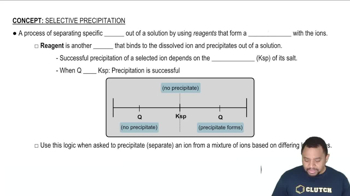
Precipitation Reactions
Precipitation reactions occur when two aqueous solutions react to form an insoluble solid, known as a precipitate. This process is driven by the formation of a compound that is not soluble in water, leading to its separation from the solution. Identifying potential precipitates involves consulting solubility rules, which dictate the solubility of various ionic compounds in water.
Recommended video:
Guided course
Selective Precipitation
Molecular Equations
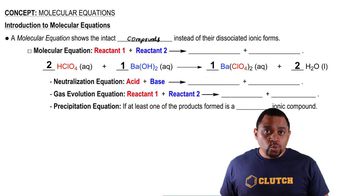
A molecular equation represents the reactants and products of a chemical reaction in their molecular form, showing all species involved. In the context of precipitation reactions, it illustrates the reactants that are mixed and the resulting products, including any precipitate formed. Balancing the equation is essential to reflect the conservation of mass and charge.
Recommended video:
Guided course
Types of Molecular Equations
Solubility Rules
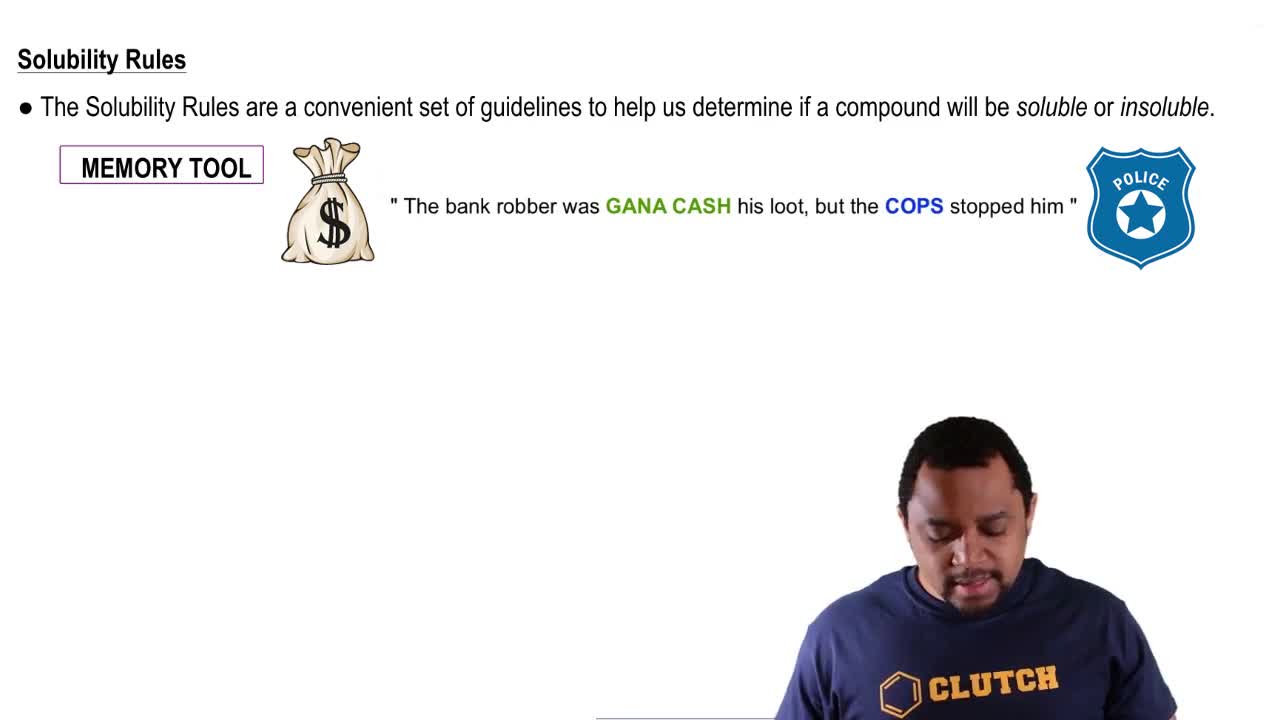
Solubility rules are guidelines that help predict whether a compound will dissolve in water or form a precipitate. These rules categorize ionic compounds based on their solubility, indicating which ions are generally soluble or insoluble in aqueous solutions. Understanding these rules is crucial for determining the outcome of mixing different ionic solutions, such as potassium carbonate and lead(II) nitrate.
Recommended video:
Guided course
Solubility Rules
Related Practice
Textbook Question
2
views
Textbook Question
Complete and balance each equation. If no reaction occurs, write 'NO REACTION.' a. NaNO3(aq) + KCl(aq) →
2
views
Textbook Question
Write a molecular equation for the precipitation reaction that occurs (if any) when each pair of aqueous solutions is mixed. If no reaction occurs, write 'NO REACTION.' a. sodium chloride and lead(II) acetate b. potassium sulfate and strontium iodide c. cesium chloride and calcium sulfide d. chromium(III) nitrate and sodium phosphate
Textbook Question
Complete and balance each equation. If no reaction occurs, write 'NO REACTION.' d. NH4Cl(aq) + AgNO3(aq) →
1
views
Textbook Question
Write balanced complete ionic and net ionic equations for each reaction. a. HCl(aq) + LiOH(aq) → H2O(l) + LiCl(aq)