What is the molarity of ZnCl2 that forms when 25.0 g of zinc completely reacts with CuCl2 according to the following reaction? Assume a final volume of 275 mL. Zn(s) + CuCl2(aq) → ZnCl2(aq) + Cu(s)
Ch.5 - Introduction to Solutions and Aqueous Solutions
Chapter 5, Problem 34
Consider the reaction: Li2S(aq) + Co(NO3)2(aq) → 2 LiNO3(aq) + CoS(s) What volume of 0.150 M Li2S solution is required to completely react with 125 mL of 0.150 M Co(NO3)2?
Verified step by step guidance1
Identify the balanced chemical equation: Li_2S(aq) + Co(NO_3)_2(aq) \(\rightarrow\) 2 LiNO_3(aq) + CoS(s).
Determine the stoichiometry of the reaction: 1 mole of Li_2S reacts with 1 mole of Co(NO_3)_2.
Calculate the moles of Co(NO_3)_2 using its concentration and volume: \(\text{moles of Co(NO}\)_3\(\text{)}\)_2 = 0.150 \(\text{ M}\) \(\times\) 0.125 \(\text{ L}\).
Use the stoichiometry of the reaction to find the moles of Li_2S needed: \(\text{moles of Li}\)_2\(\text{S}\) = \(\text{moles of Co(NO}\)_3\(\text{)}\)_2.
Calculate the volume of 0.150 M Li_2S solution required using its concentration: \(\text{Volume of Li}\)_2\(\text{S}\) = \(\frac{\text{moles of Li}\)_2\(\text{S}\)}{0.150 \(\text{ M}\)}.

Verified video answer for a similar problem:
This video solution was recommended by our tutors as helpful for the problem above.
Video duration:
2mWas this helpful?
Key Concepts
Here are the essential concepts you must grasp in order to answer the question correctly.
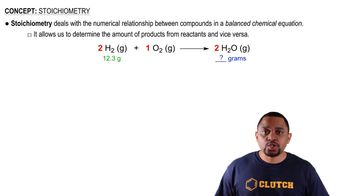
Stoichiometry
Stoichiometry is the branch of chemistry that deals with the quantitative relationships between the reactants and products in a chemical reaction. It allows us to calculate the amounts of substances consumed and produced in a reaction based on balanced chemical equations. In this case, understanding the stoichiometric coefficients from the balanced equation is essential to determine the volume of Li<sub>2</sub>S needed to react with Co(NO<sub>3</sub>)<sub>2</sub>.
Recommended video:
Guided course
Stoichiometry Concept
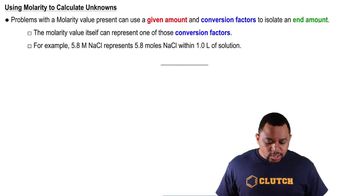
Molarity
Molarity is a measure of concentration defined as the number of moles of solute per liter of solution. It is expressed in moles per liter (M). In this problem, both Li<sub>2</sub>S and Co(NO<sub>3</sub>)<sub>2</sub> solutions are given in molarity, which is crucial for calculating the number of moles present in the given volumes and for determining how much Li<sub>2</sub>S is needed to react completely with the cobalt nitrate.
Recommended video:
Guided course
Molarity
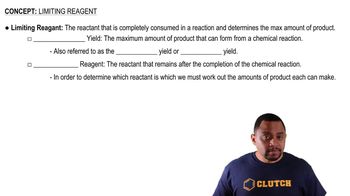
Limiting Reactant
The limiting reactant is the substance that is completely consumed first in a chemical reaction, thus determining the maximum amount of product that can be formed. Identifying the limiting reactant is key to solving stoichiometric problems, as it dictates how much of the other reactants are required. In this scenario, knowing which reactant limits the reaction will help in calculating the necessary volume of Li<sub>2</sub>S solution.
Recommended video:
Guided course
Limiting Reagent Concept
Related Practice
Textbook Question
1
views
Textbook Question
To what volume should you dilute 50.0 mL of a 12 M stock HNO3 solution to obtain a 0.100 M HNO3 solution?
Textbook Question
A 25.0-mL sample of a 1.20 M potassium chloride solution is mixed with 15.0 mL of a 0.900 M lead(II) nitrate solution and this precipitation reaction occurs: 2 KCl(aq) + Pb(NO3)2(aq) → PbCl2(s) + 2 KNO3(aq) The solid PbCl2 is collected, dried, and found to have a mass of 2.45 g. Determine the the percent yield.
1
views
Textbook Question
If 3.5 L of a 4.8 M SrCl2 solution is diluted to 45 L, what is the molarity of the diluted solution?
Textbook Question
What is the minimum amount of 6.0 M H2SO4 necessary to produce 25.0 g of H2(g) according to the reaction between aluminum and sulfuric acid? 2 Al(s) + 3 H2SO4(aq) → Al2(SO4)3(aq) + 3 H2(g)
1
views