A battery relies on the oxidation of magnesium and the reduction of Cu2+. The initial concentrations of Mg2+ and Cu2+ are 1.0 × 10⁻⁴ M and 1.5 M, respectively, in 1.0-liter half-cells. b. What is the voltage of the battery after delivering 5.0 A for 8.0 h?
A battery relies on the oxidation of magnesium and the reduction of Cu2+. The initial concentrations of Mg2+ and Cu2+ are 1.0 × 10⁻⁴ M and 1.5 M, respectively, in 1.0-liter half-cells. a. What is the initial voltage of the battery?
Verified step by step guidance
Verified video answer for a similar problem:
Key Concepts
Oxidation and Reduction
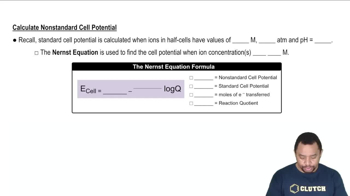
Nernst Equation
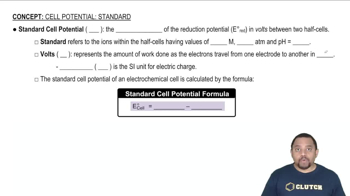
Standard Electrode Potentials
A friend wants you to invest in a new battery she has designed that produces 24 V in a single voltaic cell. Why should you be wary of investing in such a battery?
A battery relies on the oxidation of magnesium and the reduction of Cu2+. The initial concentrations of Mg2+ and Cu2+ are 1.0 × 10⁻⁴ M and 1.5 M, respectively, in 1.0-liter half-cells. c. How long can the battery deliver 5.0 A before going dead?
The cell potential of this electrochemical cell depends on the gold concentration in the cathode half-cell. Pt(s) | H2(g, 1.0 atm) | H+(aq, 1.0 M) || Au3+(aq, ? M) | Au(s) What is the concentration of Au3+ in the solution if Ecell is 1.22 V?
A rechargeable battery is constructed based on a concentration cell constructed of two Ag/Ag+ half-cells. The volume of each half-cell is 2.0 L, and the concentrations of Ag+ in the half-cells are 1.25 M and 1.0×10⁻³ M. a. How long can this battery deliver 2.5 Aof current before it goes dead?
The cell potential of this electrochemical cell depends on the pH of the solution in the anode half-cell. Pt(s) | H2(g, 1 atm) | H+(aq, ? M) || Cu2+(aq, 1.0 M) | Cu(s) What is the pH of the solution if Ecell is 355 mV?
