
Textbook Question
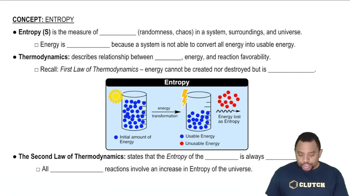
Determine ΔG° for the reaction: Fe2O3(s) + 3 CO(g) → 2 Fe(s) + 3 CO2(g) Use the following reactions with known ΔG°rxn values:
2 Fe(s) + 3/2 O2(g) → Fe2O3(s) ΔG°rxn = -742.2 kJ
CO(g) + 12 O2( g) → CO2(g) ΔG°rxn = -257.2 kJ
 Verified step by step guidance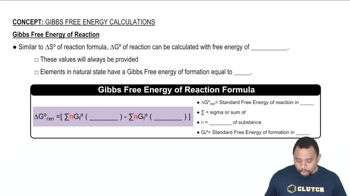
 01:51
01:51
 02:46
02:46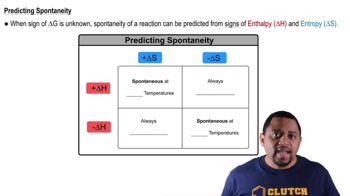 01:17
01:17Determine ΔG° for the reaction: Fe2O3(s) + 3 CO(g) → 2 Fe(s) + 3 CO2(g) Use the following reactions with known ΔG°rxn values:
2 Fe(s) + 3/2 O2(g) → Fe2O3(s) ΔG°rxn = -742.2 kJ
CO(g) + 12 O2( g) → CO2(g) ΔG°rxn = -257.2 kJ
Consider the reaction: 2 NO(g) + O2(g) → 2 NO2(g) Estimate ΔG° for this reaction at each temperature and predict whether or not the reaction is spontaneous. (Assume that ΔH° and ΔS° do not change too much within the given temperature range.) b. 715 K