Ch.16 - Acids and Bases
Tro - Chemistry: A Molecular Approach 4th Edition
Tro4th EditionChemistry: A Molecular ApproachISBN: 9780134112831Not the one you use?Change textbook
Chapter 16, Problem 44

Rank the solutions in order of decreasing [H3O+]: 0.10 M HCl; 0.10 M HF; 0.10 M HClO; 0.10 M HC6H5O.

Verified step by step guidance
1
Identify that HCl is a strong acid, which means it completely dissociates in water, producing a high concentration of \([H_3O^+]\).
Recognize that HF, HClO, and HC6H5O are weak acids, which do not completely dissociate in water, resulting in lower \([H_3O^+]\) compared to strong acids.
Understand that the strength of weak acids can be compared using their acid dissociation constants \(K_a\). The larger the \(K_a\), the stronger the acid, and the higher the \([H_3O^+]\).
Research or recall the \(K_a\) values for HF, HClO, and HC6H5O to determine their relative strengths.
Rank the solutions based on the \([H_3O^+]\) concentration, starting with the highest for the strong acid and then in order of decreasing \(K_a\) for the weak acids.

Verified video answer for a similar problem:

This video solution was recommended by our tutors as helpful for the problem above.
Video duration:
2m

Key Concepts

Here are the essential concepts you must grasp in order to answer the question correctly.

Strong vs. Weak Acids

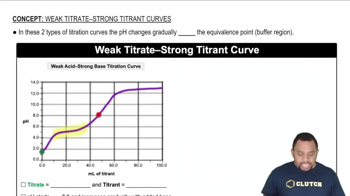
Strong acids, like HCl, completely dissociate in water, producing a high concentration of hydronium ions (H3O+). In contrast, weak acids, such as HF and HClO, only partially dissociate, resulting in a lower concentration of H3O+. Understanding this distinction is crucial for ranking the solutions based on their acidity.
Recommended video:
Guided course
02:19
Weak Acid-Strong Base Titration Curve

Concentration of Solutions

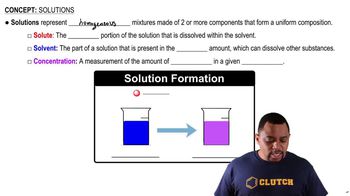
The concentration of an acid solution, expressed in molarity (M), indicates the amount of acid present in a given volume of solution. In this question, all solutions have the same concentration of 0.10 M, but their ability to produce H3O+ varies based on their strength as acids, affecting the final ranking.
Recommended video:
Guided course
01:39
Solution Components

Acid Dissociation Constant (Ka)

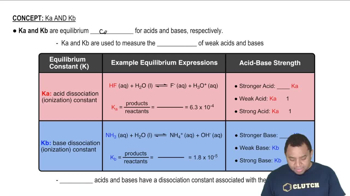
The acid dissociation constant (Ka) quantifies the strength of a weak acid in solution. A higher Ka value indicates a stronger acid that dissociates more in water, leading to a greater concentration of H3O+. For the weak acids in the question, knowing their Ka values helps determine their relative acidity and thus their ranking based on H3O+ concentration.
Recommended video:
Guided course
03:50
Characteristics of Ka and Kb