
Textbook Question
Calculate the molarity of each solution.
c. 32.4 mg NaCl in 122.4 mL of solution
1
views
 Verified step by step guidance
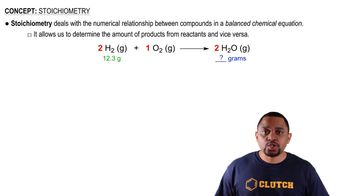
 01:16
01:16
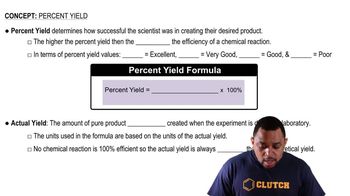 03:09
03:09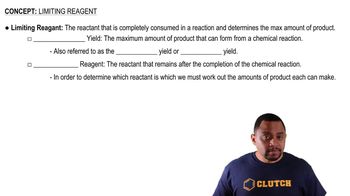 01:30
01:30Calculate the molarity of each solution.
c. 32.4 mg NaCl in 122.4 mL of solution
Calculate the molarity of each solution. a. 0.38 mol of LiNO3 in 6.14 L of solution b. 72.8 g C2H6O in 2.34 L of solution c. 12.87 mg KI in 112.4 mL of solution
Urea (CH4N2O) is a common fertilizer that is synthesized by the reaction of ammonia (NH3) with carbon dioxide: 2 NH3(aq) + CO2(aq) → CH4N2O(aq) + H2O(l) In an industrial synthesis of urea, a chemist combines 136.4 kg of ammonia with 211.4 kg of carbon dioxide and obtains 168.4 kg of urea. Determine the limiting reactant, theoretical yield of urea, and percent yield for the reaction.
Calculate the molarity of each solution.
a. 3.25 mol of LiCl in 2.78 L solution
b. 28.33 g C6H12O6 in 1.28 L of solution
Magnesium oxide can be made by heating magnesium metal in the presence of oxygen. The balanced equation for the reaction is: 2 Mg(s) + O2(g) → 2 MgO(s) When 10.1 g of Mg reacts with 10.5 g O2, 11.9 g MgO is collected. Determine the limiting reactant, theoretical yield, and percent yield for the reaction.