Identify each organic compound as an alkane, alkene, alkyne, aromatic hydrocarbon, alcohol, ether, aldehyde, ketone, carboxylic acid, ester, or amine, and provide a name for the compound. c.
Ch.21 - Organic Chemistry
Chapter 21, Problem 88c
List the products of each amine reaction. c.
Verified step by step guidance1
Identify the type of amine involved in the reaction. Amines can be primary, secondary, or tertiary, depending on the number of alkyl or aryl groups attached to the nitrogen atom.
Determine the type of reaction the amine is undergoing. Common reactions include alkylation, acylation, and reactions with acids to form ammonium salts.
For alkylation, consider the reaction of the amine with an alkyl halide, which typically results in the formation of a more substituted amine and a halide ion as a byproduct.
For acylation, consider the reaction of the amine with an acyl chloride or anhydride, which typically results in the formation of an amide and a molecule of HCl or a carboxylic acid as a byproduct.
For reactions with acids, consider the formation of an ammonium salt, where the amine accepts a proton from the acid, resulting in a positively charged ammonium ion and the corresponding anion from the acid.

Verified video answer for a similar problem:
This video solution was recommended by our tutors as helpful for the problem above.
Video duration:
2mWas this helpful?
Key Concepts
Here are the essential concepts you must grasp in order to answer the question correctly.
Amine Structure and Classification
Amines are organic compounds derived from ammonia (NH3) by replacing one or more hydrogen atoms with alkyl or aryl groups. They are classified into primary, secondary, and tertiary amines based on the number of carbon-containing groups attached to the nitrogen atom. Understanding the structure of amines is crucial for predicting their reactivity and the types of products formed in chemical reactions.
Recommended video:
Guided course
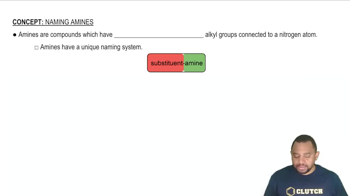
Rules for Naming Amines
Reactions of Amines
Amines participate in various chemical reactions, including nucleophilic substitution, acylation, and alkylation. In nucleophilic substitution, amines can react with alkyl halides to form substituted amines. Additionally, amines can react with carbonyl compounds to form amides, showcasing their versatility in organic synthesis and the formation of diverse products.
Recommended video:
Guided course
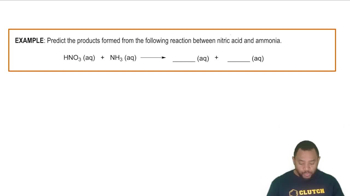
Amine Reactions Example
Product Identification in Organic Reactions
Identifying the products of amine reactions requires knowledge of reaction mechanisms and the functional groups involved. For instance, when amines react with acids, they typically form ammonium salts. Understanding the specific conditions and reactants involved in each reaction helps predict the resulting products, which is essential for effective synthesis in organic chemistry.
Recommended video:
Guided course
Production of Hydrogen Example
Related Practice
Textbook Question
Textbook Question
List the products of each amine reaction. a.
Textbook Question
Identify each organic compound as an alkane, alkene, alkyne, aromatic hydrocarbon, alcohol, ether, aldehyde, ketone, carboxylic acid, ester, or amine, and provide a name for the compound. e.
Textbook Question
List the products of each amine reaction. b.
Textbook Question
Classify each amine reaction as acid–base or condensation and list its products.
c. CH3NH2 + H2SO4 →
Textbook Question
Identify each organic compound as an alkane, alkene, alkyne, aromatic hydrocarbon, alcohol, ether, aldehyde, ketone, carboxylic acid, ester, or amine, and provide a name for the compound. a.