
Given the values of ΔH°rxn, ΔS°rxn, and T, determine ΔSuniv and predict whether or not each reaction is spontaneous. (Assume that all reactants and products are in their standard states.) c. ΔH°rxn = -115 kJ; ΔS°rxn = -263 J/K; T = 298 K
Ch.18 - Free Energy and Thermodynamics
Chapter 18, Problem 42a
Given the values of ΔH°rxn, ΔS°rxn, and T, determine ΔSuniv and predict whether or not each reaction is spontaneous. (Assume that all reactants and products are in their standard states.) a. ΔH°rxn = -95 kJ; ΔS°rxn = -157 J/K; T = 298 K
Verified step by step guidance1
Calculate the change in Gibbs free energy (ΔG°rxn) using the formula ΔG°rxn = ΔH°rxn - TΔS°rxn. Convert ΔH°rxn from kJ to J by multiplying by 1000 to ensure consistent units.
Substitute the given values into the equation: ΔH°rxn = -95000 J, ΔS°rxn = -157 J/K, and T = 298 K.
Calculate ΔG°rxn by performing the arithmetic operation: ΔG°rxn = -95000 J - (298 K × -157 J/K).
Determine the sign of ΔG°rxn. If ΔG°rxn is negative, the reaction is spontaneous; if positive, it is non-spontaneous.
Calculate ΔSuniv using the formula ΔSuniv = -ΔG°rxn / T. Substitute the calculated ΔG°rxn and given T into the formula to find ΔSuniv.

Verified video answer for a similar problem:
This video solution was recommended by our tutors as helpful for the problem above.
Video duration:
4mWas this helpful?
Key Concepts
Here are the essential concepts you must grasp in order to answer the question correctly.
Gibbs Free Energy
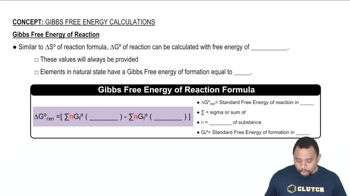
Gibbs Free Energy (G) is a thermodynamic potential that helps predict the spontaneity of a reaction at constant temperature and pressure. It is calculated using the equation ΔG = ΔH - TΔS, where ΔH is the change in enthalpy, T is the temperature in Kelvin, and ΔS is the change in entropy. A negative ΔG indicates that a reaction is spontaneous, while a positive ΔG suggests it is non-spontaneous.
Recommended video:
Guided course
Gibbs Free Energy of Reactions
Entropy (ΔS)
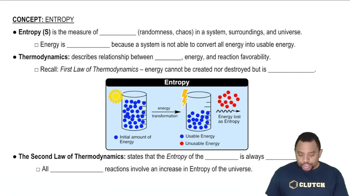
Entropy (ΔS) is a measure of the disorder or randomness in a system. In the context of a chemical reaction, it quantifies the change in disorder between reactants and products. A positive ΔS indicates an increase in disorder, which generally favors spontaneity, while a negative ΔS suggests a decrease in disorder, which can hinder spontaneity.
Recommended video:
Guided course
Entropy in Thermodynamics
Enthalpy (ΔH)
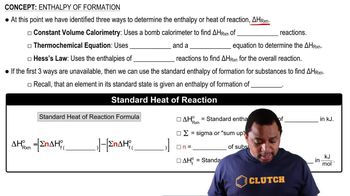
Enthalpy (ΔH) is a measure of the total heat content of a system and reflects the energy changes during a chemical reaction. A negative ΔH indicates that the reaction is exothermic, releasing heat, which often contributes to spontaneity. Conversely, a positive ΔH indicates an endothermic reaction, absorbing heat, which may require other factors, such as an increase in entropy, to be spontaneous.
Recommended video:
Guided course
Enthalpy of Formation
Related Practice
Textbook Question
Textbook Question
Calculate the change in Gibbs free energy for each of the sets of ΔHrxn, ΔSrxn, and T given in Problem 42. Predict whether or not each reaction is spontaneous at the temperature indicated. (Assume that all reactants and products are in their standard states.)
Textbook Question
Given the values of ΔH°rxn, ΔS°rxn, and T, determine ΔSuniv and predict whether or not each reaction is spontaneous. (Assume that all reactants and products are in their standard states.) c. ΔH°rxn = +95 kJ; ΔS°rxn = -157 J/K; T = 298 K
Textbook Question
Given the values of ΔH°rxn, ΔS°rxn, and T, determine ΔSuniv and predict whether or not each reaction is spontaneous. (Assume that all reactants and products are in their standard states.) a. ΔH°rxn = +115 kJ; ΔS°rxn = -263 J/K; T = 298 K
