
Textbook Question
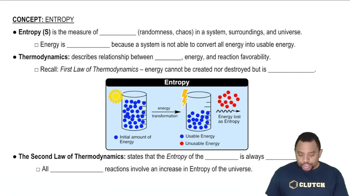
Without doing any calculations, determine the sign of ΔSsys for each chemical reaction. a. 2 KClO3(s) → 2 KCl(s) + 3 O2(g) c. Na(s) + 2 Cl2(g) → NaCl(s) d. N2(g) + 3 H2(g) → 2 NH3(g)
1
views
 Verified step by step guidance
 02:46
02:46
 02:19
02:19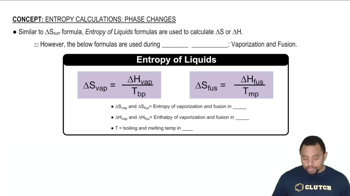 01:46
01:46Without doing any calculations, determine the sign of ΔSsys for each chemical reaction. a. 2 KClO3(s) → 2 KCl(s) + 3 O2(g) c. Na(s) + 2 Cl2(g) → NaCl(s) d. N2(g) + 3 H2(g) → 2 NH3(g)
Two systems, each composed of two particles represented by circles, have 20 J of total energy. Which system, A or B, has the greater entropy? Why?
Calculate the change in entropy that occurs in the system when 1.00 mole of isopropyl alcohol (C3H8O) melts at its melting point (-89.5 °C). See Table 11.9 for heats of fusion.
Two systems, each composed of three particles represented by circles, have 30 J of total energy. How many energetically equivalent ways can you distribute the particles in each system? Which system has greater entropy?