
Dinitrogen tetroxide decomposes to nitrogen dioxide: N2O4(g) → 2 NO2(g) ΔH°rxn = 55.3 kJ At 298 K, a reaction vessel initially contains 0.100 atm of N2O4. When equilibrium is reached, 58% of the N2O4 has decomposed to NO2. What percentage of N2O4 decomposes at 388 K? Assume that the initial pressure of N2O4 is the same (0.100 atm).
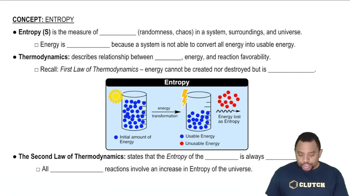
All the oxides of nitrogen have positive values of ΔG°f at 298 K, but only one common oxide of nitrogen has a positive ΔS°f. Identify that oxide of nitrogen without reference to thermodynamic data and explain.
Verified step by step guidance
Verified video answer for a similar problem:
Key Concepts
Gibbs Free Energy (ΔGf°)
Entropy (ΔS°f)
Nitrogen Oxides
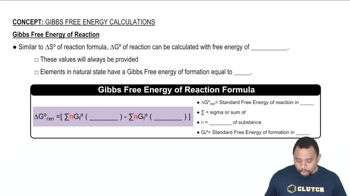
These reactions are important in catalytic converters in automobiles. Calculate ΔG° for each at 298 K. Predict the effect of increasing temperature on the magnitude of ΔG°.
a. 2 CO(g) + 2 NO(g) → N2(g) + 2 CO2(g)
b. 5 H2(g) + 2 NO(g) → 2 NH3(g) + 2 H2O(g)
c. 2 H2(g) + 2 NO(g) → N2(g) + 2 H2O(g)
d. 2 NH3(g) + 2 O2(g) → N2O(g) + 3 H2O(g)
The values of ΔG°f for the hydrogen halides become less negative with increasing atomic number. The ΔG°f of HI is slightly positive. However, the trend in ΔS°f is to become more positive with increasing atomic number. Explain.
Calculate ΔG° at 298 K for these reactions and predict the effect on ΔG° of lowering the temperature.
a. NH3(g) + HBr(g) → NH4Br(s)
b. CaCO3(s) → CaO(s) + CO2(g)
c. CH4(g) + 3 Cl2(g) → CHCl3(g) + 3 HCl(g) (ΔG°f for CHCl3(g) is -70.4 kJ/mol.)
